Against the Odds
Born Without a Right Hand — He Threw a No-Hitter for the Yankees
Six days before Jim Abbott pitched the greatest game of his major-league career, the Cleveland Indians had absolutely demolished him.
On August 29, 1993, Cleveland scored seven runs and collected 10 hits against the New York Yankees pitcher before he could even finish the fourth inning. The Yankees eventually came back to win 14–8, but Abbott’s performance was one he’d rather forget.
His next scheduled start was September 4, and unfortunately for Abbott, he would be facing those very same Cleveland hitters again. What happened that afternoon would become one of the most remarkable games in Yankees history.
Learning to Play Baseball With One Hand
Jim Abbott was born in Southfield, Michigan, on September 19, 1967, without a right hand. He grew up in Flint, where he developed a love of sports and became determined to play baseball.
Pitching wasn’t the biggest challenge. Abbott was naturally left-handed, so he could throw a baseball just fine. The difficult part was figuring out how to catch a ball and throw it again using the same hand.
With help from his father, Mike, he developed a quick glove-switching technique. Abbott held his glove against his right forearm while pitching. As soon as he released the ball with his left hand, he slipped the glove onto that hand so he could field anything hit back toward him.
If he caught a ball, he could remove the glove and make the throw with his left hand. The movement required plenty of practice, but eventually he could make the switch almost without thinking about it.
By high school, Abbott had become an outstanding athlete. At Flint Central High School, he excelled as a pitcher and also played quarterback on the football team.
During his senior baseball season, he went 10–3 with a remarkable 0.75 earned run average and struck out 148 batters in just 73 innings.
From College Baseball to Olympic Gold
The Toronto Blue Jays selected Abbott in the 36th round of the 1985 Major League Baseball draft, but he decided to attend the University of Michigan instead. There, he became one of the country’s top college pitchers and helped Michigan win two Big Ten championships. In 1987, he received the Golden Spikes Award as the nation’s best amateur baseball player.
A year later, Abbott represented the United States at the 1988 Summer Olympics in Seoul, South Korea. He pitched in the gold-medal game as the Americans defeated Japan to win the tournament.
By then, major-league teams had taken notice. The California Angels selected Abbott with the eighth overall pick in the 1988 draft. But instead of sending him through the minor leagues to gain experience, the Angels decided he was ready for the majors immediately.
He Skipped the Minor Leagues Entirely
Abbott made his major-league debut on April 8, 1989, against the Seattle Mariners. He struggled in that first appearance, giving up three earned runs in fewer than five innings, and the Angels lost 7–0.
But he quickly showed that he belonged. He finished his rookie season with 12 wins, 12 losses and a respectable 3.92 earned run average.
By 1991, he had become one of the American League’s better starting pitchers. That year, Abbott won 18 games, posted a 2.89 ERA and finished third in voting for the American League Cy Young Award.
He joined the New York Yankees before the 1993 season. Unfortunately, his first year in New York was proving difficult, and by early September, he had nine wins, 11 losses and an ERA above 4.00. Then came that disastrous outing against Cleveland, followed by the rematch just six days later.
Nine Innings at Yankee Stadium
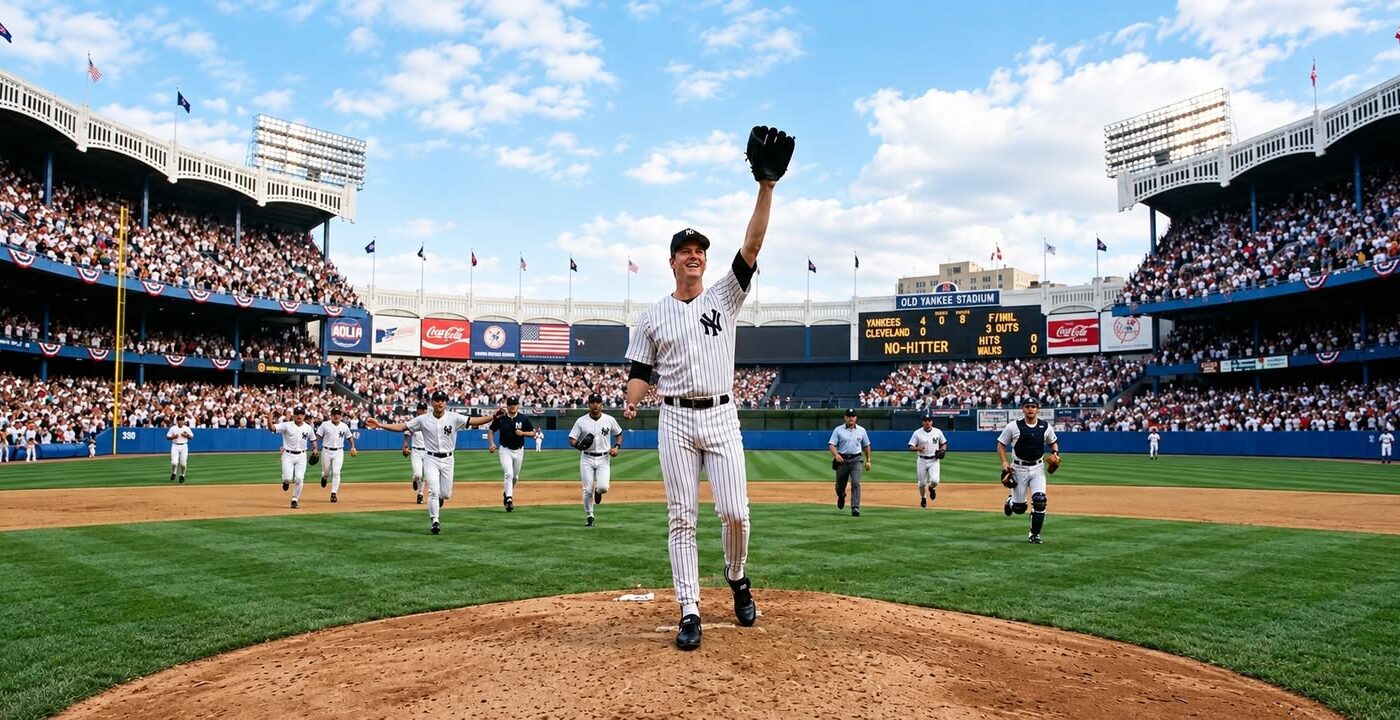
On September 4, 1993, Abbott took the mound at Yankee Stadium in front of 27,225 fans. Cleveland’s lineup included dangerous hitters such as Albert Belle, Kenny Lofton and Carlos Baerga.
But this time, Abbott was keeping the Indians off balance. They were making contact with his pitches, yet every ball they put in play seemed to find a Yankees defender.
He wasn’t overpowering hitters with strikeouts. In fact, he would finish the game with only three. He also walked five batters, which meant Cleveland had opportunities to threaten without ever getting a hit.
The Yankees scored three runs in the third inning and added another in the fifth when Randy Velarde hit a solo home run. Abbott now had a four-run lead to work with.
As the game continued, the Yankees’ defense helped preserve his remarkable performance. In the seventh inning, third baseman Wade Boggs made a diving play to take a potential hit away from Albert Belle.
Abbott kept working through the Cleveland lineup. By the end of the eighth inning, not a single batter had managed a hit against him.
Three Outs Away From History
Abbott returned to the mound for the ninth inning with a 4–0 lead and a chance to make baseball history.
Kenny Lofton was the first batter. At one point, he tried bunting down the third-base line, hoping to catch the Yankees off guard. The ball rolled foul, and some fans booed the attempt.
Abbott later said he didn’t consider the bunt unfair. Lofton was simply trying to get his team a hit.
Lofton eventually grounded out to second baseman Mike Gallego. One down.
Next came Felix Fermin, who hit a deep fly ball to center field. Bernie Williams caught it for the second out.
That left Carlos Baerga as Cleveland’s final chance. Baerga hit a ground ball toward shortstop Randy Velarde, who fielded it and threw to first baseman Don Mattingly.
Mattingly made the catch, completing the final out. Jim Abbott had thrown 119 pitches over nine innings, walked five batters and allowed absolutely no hits.
The Yankees had won 4–0.