Remarkable Stories
She Left a Ukrainian Orphanage Weighing 35 Pounds and Won Paralympic Gold
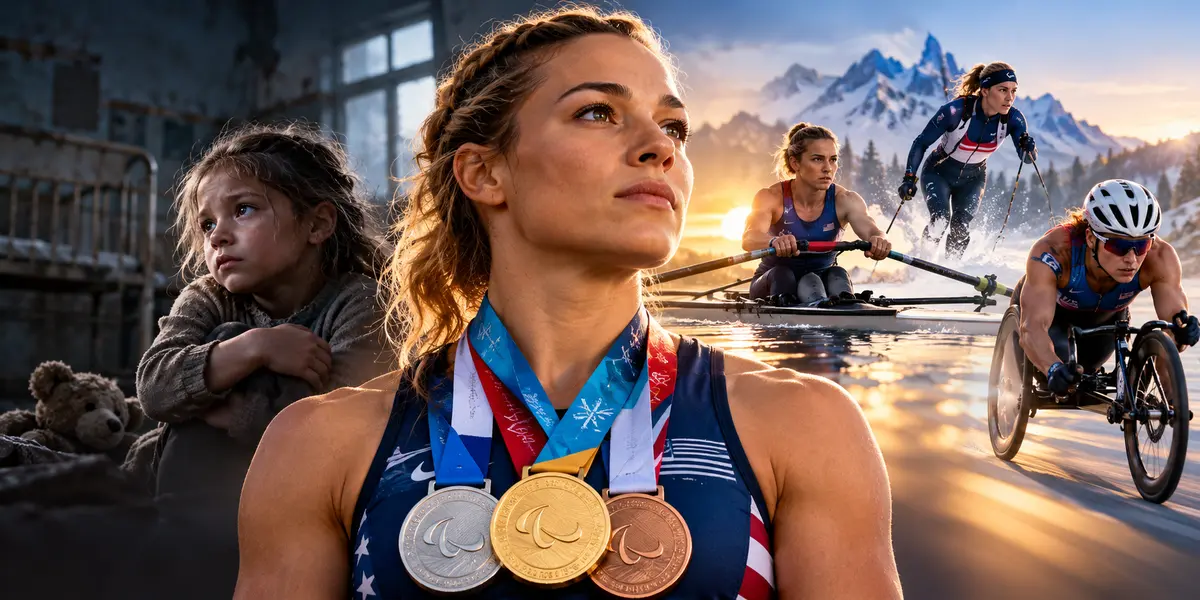
Gay Masters was looking through a Ukrainian adoption booklet when she came across a photograph of a little girl named Oksana. The child had been born with serious physical disabilities and had spent her entire life in orphanages.
Other prospective parents had come and gone. But Gay, a single American woman who wanted to become a mother, felt an immediate connection to the girl in the photograph.
She decided she wanted to bring Oksana home. Getting her out of Ukraine would take more than two years of paperwork, delays, and determination, but Gay refused to give up.
Seven Years Old and Only 35 Pounds
Oksana Masters was born in Ukraine in 1989 with severe differences affecting her arms, hands, and legs. She had webbed fingers, no thumbs, and was missing several bones needed to support her weight. She was also born with only one kidney.
Given up for adoption as a baby, she spent her first seven years moving between three orphanages. Food was often scarce, and she endured years of mistreatment that would affect her long after she left.
When Gay finally brought Oksana to the United States in 1996, the little girl weighed just 35 pounds. She was nearly eight years old and had never experienced anything resembling a normal family life.
The two couldn’t even speak the same language at first. They communicated through gestures while Oksana gradually learned English and began adjusting to life in America.
Her Mother Helped Her Through Years of Surgery
Oksana’s medical needs were extensive. Because of the way her legs had developed, walking was painful and difficult, and doctors eventually determined that amputation would give her better mobility.
Her left leg was amputated when she was nine, followed by her right leg at fourteen. She also underwent several surgeries to reconstruct her hands, including procedures to improve her ability to grip and hold objects.
Learning to use prosthetic legs brought another set of challenges. At school, Oksana often felt uncomfortable with her appearance and tried to hide her prosthetics beneath long pants.
Gay wanted her daughter to have something enjoyable to focus on outside medical appointments and rehabilitation. When Oksana was thirteen, she encouraged her to try adaptive rowing.
Oksana wasn’t particularly interested. She had spent years being treated differently because of her disabilities and didn’t want another activity that seemed to remind her of them. But she agreed to give it a try.
Everything Changed When She Got Into a Boat
The moment Oksana pushed away from the dock, she discovered something she hadn’t expected. On the water, she could move under her own power, control her speed, and concentrate entirely on what her body could do.
Rowing quickly became her favorite activity. She trained harder, developed her technique, and found that the physical effort helped her deal with emotions she’d struggled to express for years.
Eventually, she began competing seriously and set her sights on the Paralympic Games. She tried to qualify for Beijing in 2008 but didn’t make the American team.
Four years later, she got another opportunity. At the 2012 London Paralympics, Oksana competed alongside former U.S. Marine Rob Jones in the mixed double sculls rowing competition.
The pair finished third, narrowly beating Great Britain to claim the bronze medal. It was the first time the United States had won a Paralympic medal in that rowing event.
For Oksana, who had spent so much of her childhood feeling that she didn’t belong, standing on the podium was an experience she would never forget.
A Back Injury Forced Her to Start Again
Just as her rowing career was taking off, Oksana developed a serious back injury. Years of training had taken their toll, and doctors warned that continuing to row could require major surgery.
She was devastated. Rowing had become such a central part of her life that she hadn’t seriously considered doing anything else.
Then someone introduced her to cross-country skiing. Oksana had never tried the sport, but she agreed to give it a chance and began learning to race using a specially designed sit-ski.
Within a little more than a year, she qualified for the 2014 Winter Paralympics in Sochi, Russia. She came home with two medals, a silver and a bronze, proving she could compete internationally in a completely different sport.
She eventually added biathlon, which combines skiing with target shooting, and took up competitive hand cycling as well.
She Returned to Ukraine in 2015
Nineteen years after leaving Ukraine, Oksana returned to the country where she’d spent her childhood. The trip brought back painful memories, especially when she visited an orphanage and recognized familiar smells and surroundings.
During the visit, she met children who reminded her of herself at their age. One little girl followed her as she was leaving and gave her a hug, a moment Oksana later described with particular affection.
She also visited a military hospital where Ukrainian soldiers were recovering from serious injuries. Some had lost limbs and were adjusting to a life they hadn’t expected.
While speaking with the soldiers, Oksana removed one of her prosthetic legs and handed it over for them to examine. The unexpected gesture made some of the men laugh and helped start a conversation about prosthetics, mobility, and recovery.
She showed them how easily she could remove and reattach the leg, and how comfortably she could move with it. The visit allowed her to share years of personal experience with people who were only beginning that process.
She Went On to Win Gold in Three Different Sports
Oksana continued improving as a skier and biathlete. At the 2018 Winter Paralympics in PyeongChang, she finally won her first Paralympic gold medals, taking two golds along with two silvers and a bronze.
She also became one of the world’s top hand cyclists. At the Tokyo 2020 Paralympics, held in 2021, she won two cycling gold medals. She repeated that success at Paris 2024, winning another two golds in the women’s road race and time trial.
By then, she’d established herself as one of the few athletes capable of winning Paralympic medals in both summer and winter sports. Her schedule meant continually switching between the strength and training demands of cycling, skiing, and biathlon.
And she wasn’t finished. At the Milano Cortina 2026 Winter Paralympics, Oksana won four gold medals and one bronze, adding five more medals to her career total.
She had now competed in eight Paralympic Games and collected 24 medals altogether: 13 gold, seven silver, and four bronze. She was also the most decorated American Winter Paralympian in history.
A Little Girl Saw Her on Television
For much of her life, Oksana had been uncomfortable showing her prosthetic legs. She wore clothes that covered them and spent years wishing she looked like everyone else.
As her sporting career progressed, she gradually became more comfortable with her appearance. She began sharing photographs of herself wearing her prosthetics openly, hoping other people with disabilities might feel comfortable doing the same.
One day, a mother contacted Oksana through social media with a story about her thirteen-year-old daughter. The girl had a prosthetic leg and had always been uncomfortable letting other children see it.
But she’d recently seen a photograph of Oksana proudly showing her prosthetic legs.
The next morning, the little girl decided to wear a dress to school, leaving her own prosthetic leg uncovered.