Changing Lives
His Wife Died, So He Cut Through a Mountain
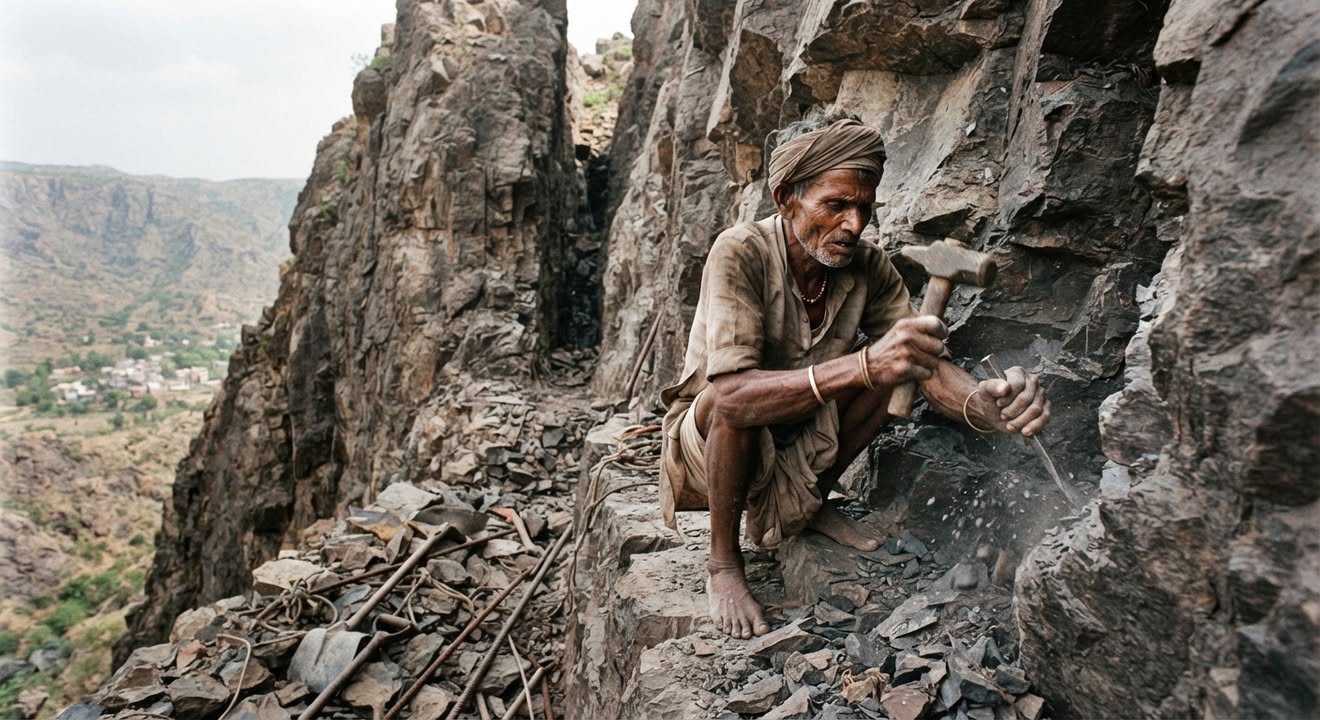
In 1960, a laborer named Dashrath Manjhi picked up a hammer and chisel and began breaking apart a mountain near his village in Bihar, India.
He had no construction equipment, no money to hire workers and no experience building roads. But he had decided that the mountain needed an opening, and he was going to make one himself. It was a decision that would consume the next 22 years of his life.
The Mountain Had Already Taken His Wife
Manjhi lived in Gehlaur, a small village surrounded by difficult terrain. A steep, rocky ridge stood between the village and nearby communities, forcing residents to travel a long distance around the mountain whenever they needed to reach the other side.
That made ordinary things unnecessarily difficult. Going to school, visiting a market or reaching medical care could mean taking a long detour, even when the destination was only a short distance away.
Then Manjhi’s wife, Falguni Devi, was seriously injured while crossing the rocky terrain. She needed medical attention, but the nearest hospital was a long journey away. Help couldn’t be reached quickly enough, and she died.
Manjhi was devastated. He had lost his wife, and he knew that other families living in Gehlaur faced the same dangerous journey whenever someone became sick or injured.
He decided to do something about it. If the mountain forced everyone to travel around it, he would make a path straight through.
One Man Against a Mountain
Manjhi was a poor laborer with little money and no engineering training. There was no government road project underway and no construction crew waiting to help him. He bought a hammer and chisel and started working on the rocky hillside himself.
At first, people in the surrounding villages thought he had lost his mind. The idea of one man cutting a road through solid rock seemed impossible, especially when he had nothing more than a few hand tools.
But Manjhi kept working. He struck the rock, cleared away the broken pieces and returned to do it again. He still had to earn a living, so the work continued alongside the everyday struggle to support himself.
Progress was painfully slow. There were no machines to break apart large sections of stone, and every bit of the opening had to be made by hand.
Some villagers eventually began supporting him, bringing food or helping him obtain tools. Even so, the enormous job of cutting through the ridge remained largely his own.
Years passed, and the opening gradually became wider and deeper. The project that people had once dismissed as impossible was beginning to look like an actual passage.
Twenty-Two Years of Hammering
Manjhi continued working from around 1960 until 1982. By the time he finished, he had carved a passage approximately 360 feet long and 30 feet wide, cutting as much as 25 feet down through the rock.
The change was enormous for the surrounding communities. According to Bihar’s tourism department, the new route shortened travel between the Atri and Wazirganj areas from roughly 55 kilometres to just 15 kilometres. That was about 40 kilometres of unnecessary travel eliminated by one man with a hammer and chisel.
For villagers, the shortcut made reaching schools, markets, jobs and medical facilities much easier. Children could attend schools that had previously been too far away, and families could reach nearby communities without making the long journey around the ridge.
The passage wasn’t a modern paved highway. It was a rough opening through the rock, but it was wide enough for people to walk through and for bicycles and motorcycles to pass.
And people were using it. Residents from nearby villages began traveling through the mountain along a route that hadn’t existed when Manjhi started his work.
India Finally Recognized the Mountain Man
Word of Manjhi’s achievement gradually spread beyond Gehlaur. He became known across India as the Mountain Man, and his extraordinary effort began attracting national attention.
In 2006, Bihar’s Chief Minister Nitish Kumar invited him to a meeting and gave him an unusual honor. Kumar asked Manjhi to sit in the chief minister’s own chair, recognizing the extraordinary work he had done for his community.
For a man who had spent much of his life working as a poor laborer, the recognition was a remarkable change. His work had started with a personal tragedy, but it had eventually improved daily life for thousands of people living around the mountain.
Manjhi died in August 2007 after receiving treatment for cancer in New Delhi. The Bihar government brought his body back to Gaya and gave him a state funeral.
The passage he created later became a memorial site, and in December 2016, India Post issued a postage stamp featuring his portrait.
The Road He Never Got to See
Manjhi had spent years asking the government to improve road access to Gehlaur. Although villagers were already using the passage he carved, the community still needed a proper paved road.
In 2011, four years after his death, the government finally completed a paved road to the village.
Today, visitors can travel to the Dashrath Manjhi Memorial and see the enormous opening he spent 22 years cutting through the mountain.