Everyday Heroes
They Saw a Plane Crash 3,000 Feet Below. Three Skydivers Jumped Straight Toward It
Jonah Johnson was flying a plane full of skydivers over Wisconsin when he noticed another aircraft disappear behind a line of trees. Everyone watched, expecting the little white plane to climb back into view.
It never did. Johnson circled around and spotted a crashed aircraft in a cornfield below. There were four people aboard, and nobody in his plane knew whether they were hurt or how quickly emergency crews could reach them.
Then three of his passengers came up with an idea. They already had parachutes, and they were directly above the accident. Why not jump down and help?
Their Afternoon Took an Unexpected Turn
It was September 27, 2026, near East Troy Municipal Airport in Wisconsin. Johnson, a 24-year-old pilot with Skydive Milwaukee, was flying a Cessna Caravan carrying experienced skydivers.
The group had planned an ordinary afternoon of recreational skydiving, jumping from around 14,000 feet. But another small plane, a Beechcraft Debonair, had developed trouble near the airport.
Johnson had seen it drop behind the trees, and his passengers had noticed it too. One of them, John Bechtel, had been skydiving for more than 30 years. He later recalled that everyone looked at one another, wondering whether they’d just witnessed a crash.
Johnson began circling the area, looking for the aircraft. When he spotted the wreckage among the crops, he immediately contacted air traffic control to report what he’d seen.
He also offered to drop some of his skydivers near the wreck. Several passengers had previous emergency medical training, and they believed they could reach the occupants faster than rescuers traveling along the surrounding roads. Air traffic control gave Johnson permission to proceed.
Three Parachutes Opened Over the Field
Sean Plastine, John Bechtel, and Kevin Flynn agreed to make the jump. They were experienced skydivers, but this was something none of them had expected to do that afternoon.
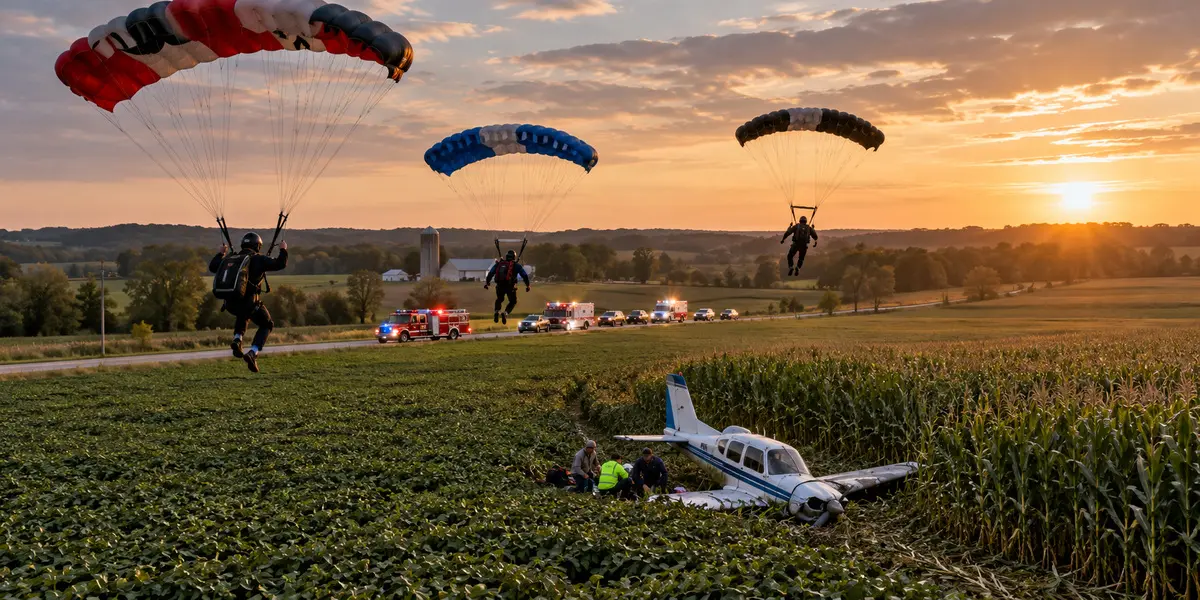
Instead of climbing to their planned altitude of 14,000 feet, Johnson positioned the aircraft around 3,000 feet above the area. The three men prepared their parachutes and jumped toward a bean field beside the crashed plane.
They landed safely, gathered their gear, and immediately started working out how to reach the wreckage. From the air, its location had been easy to see. On the ground, the surrounding crops were a different story.
Cornstalks stood roughly ten feet tall, making it almost impossible to see where the aircraft had gone down. Bechtel and Flynn headed into the cornfield, following the direction they’d seen from above. Plastine took another route, running toward the road so he could help guide firefighters and ambulances to the correct location.
Two Former EMTs Reached the Wreckage
Flynn and Bechtel had both worked as emergency medical technicians. Their training suddenly became useful as they searched through the corn for the downed plane.
At first, they couldn’t see the aircraft at all. Flynn began calling out, waiting for someone to answer. Eventually, people near the wreckage shouted back, allowing him to follow their voices.
When the men reached the plane, they found the passengers alive. One woman had suffered a head injury and was bleeding, so Flynn began helping her while checking that she was alert and responsive.
They stayed with the passengers as emergency crews made their way through the fields. Meanwhile, Plastine had reached the roadway and was helping responders find the crash site.
Within minutes, paramedics, firefighters, and police officers began arriving. The emergency teams took over medical care and helped transport the people who needed further examination.
All Four People Survived
The crashed Beechcraft had been carrying four people. Three were taken to a hospital for medical evaluation, while the fourth was examined at the scene and released.
The Federal Aviation Administration later reported that one passenger had suffered a minor injury and the others were uninjured. Early findings pointed to engine trouble, although investigators continued examining the accident.
The skydivers’ quick arrival had helped get medical assistance to the passengers while emergency vehicles were still approaching the difficult-to-reach field. Skydive Milwaukee publicly thanked Johnson and the three jumpers for their actions. The organization also praised the local police, firefighters, paramedics, and dispatchers who had worked together during the emergency.
Bechtel later explained how unusual the experience had been. After three decades of skydiving, he’d never jumped from an aircraft specifically to help someone in an emergency.
But he said he’d do it again without hesitation.
They Went Back to Their Regular Jobs
After landing his Cessna at East Troy Municipal Airport, Johnson returned to his scheduled skydiving flights later that afternoon. He kept an eye on the accident site as his passengers continued with their jumps.
The three men who had parachuted into the fields eventually gathered their equipment and headed home. They’d spent part of their Sunday helping strangers after an airplane crash, and now they had their ordinary responsibilities waiting.
Sean Plastine, a 38-year-old mechanical engineer, had work the next morning. He later told The Washington Post how strange it felt to do something like that on a Sunday and return to his regular job on Monday.
Then he thought about the firefighters, paramedics, and other emergency workers who do the same thing all the time.