Changing Lives
She Was Arrested for Showing Starving Children
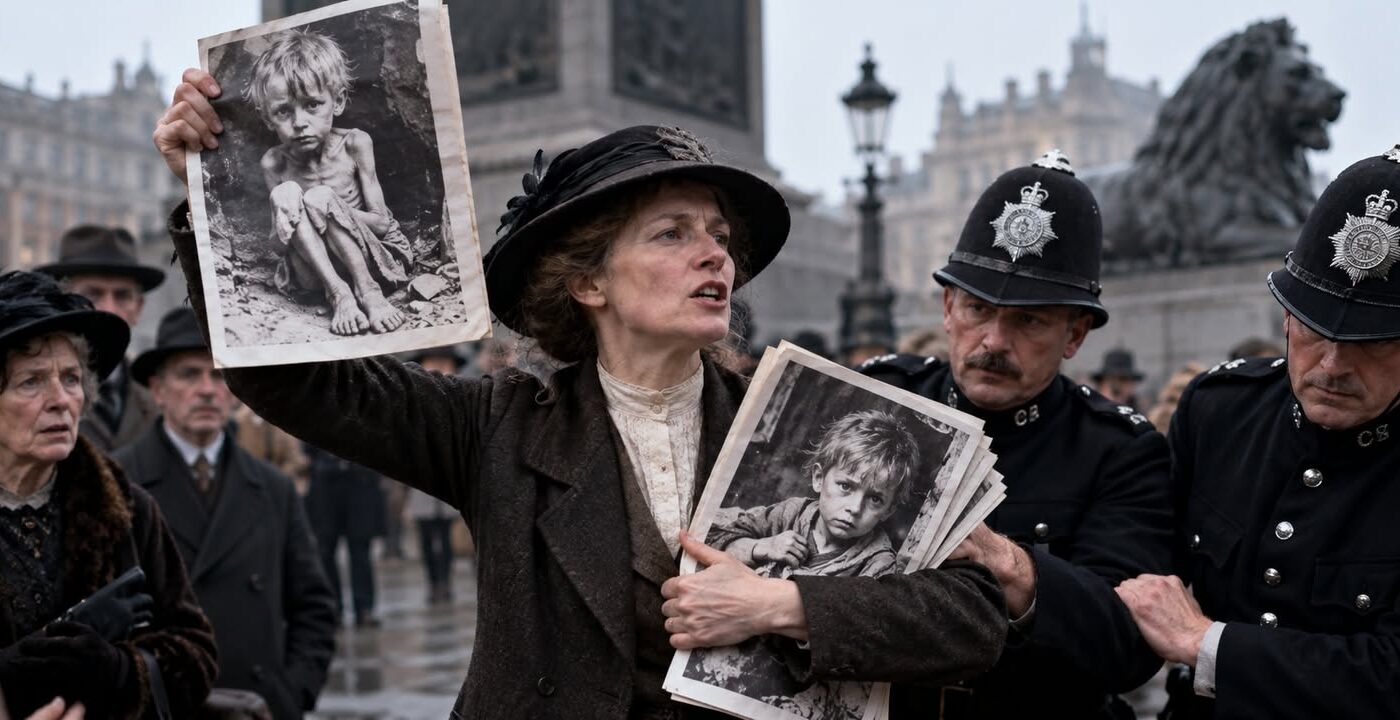
In April 1919, Eglantyne Jebb stood in London’s Trafalgar Square handing out leaflets showing starving children. One featured a photograph of a two-and-a-half-year-old Austrian child who weighed just 12 pounds and 2 ounces, less than half the expected weight for a child that age.
World War I had ended months earlier, but food shortages and continuing blockades were still causing terrible suffering across Europe. Jebb wanted the British public to see what was happening in countries they had recently fought against.
Her leaflets accused the Allied blockade of contributing to the hunger. The authorities arrested her for distributing the material, and she was ordered to appear in court.
Helping the Children of Former Enemies
Jebb and her sister, Dorothy Buxton, had spent years gathering information about civilian suffering across Europe. They followed reports of food shortages, disease and children dying from malnutrition. After the war ended in November 1918, the sisters became involved in the Fight the Famine Council, which campaigned to improve food supplies and provide relief to struggling communities.
It was a difficult cause to promote in Britain. Countless families had lost loved ones during the war, and asking them to send food or money to Germany and Austria was not particularly popular.
But Jebb believed children should never be punished for decisions made by their governments. She was determined to help them, regardless of which country they came from.
The Prosecutor Gave Her £5
In May 1919, Jebb appeared in court charged under the Defence of the Realm Act, a wartime law that allowed the government to restrict certain public activities and publications. She was found guilty and fined £5. The prosecutor was Sir Archibald Bodkin, a respected lawyer who would later become Britain’s Director of Public Prosecutions.
According to Jebb’s biographer Clare Mulley, Bodkin was impressed by her determination and the cause she was fighting for. At the end of the proceedings, he gave her £5 from his own pocket.
Jebb had already paid her fine herself, so she put his money toward the organization she was preparing to launch. It became one of the earliest donations to Save the Children.
Save the Children Was Born Four Days Later
On May 19, 1919, just four days after her court appearance, Jebb and her supporters held a public meeting at London’s Royal Albert Hall.
The event was called “A Peace of Reconciliation: Fight the Famine.” Jebb, her sister Dorothy and several other speakers called on people to support relief efforts for children suffering across Europe. That meeting marked the official beginning of the Save the Children Fund.
The organization began raising money for food, medicine and emergency supplies. It used newspaper advertisements, public meetings and photographs to encourage donations and show supporters how their money was being used.
Support grew quickly. In 1920, an international Save the Children organization was established in Geneva to coordinate relief efforts across borders.
When famine devastated parts of Russia in 1921 and 1922, the organization joined a major international relief operation. According to Save the Children’s historical records, it supplied approximately 600 tons of food and medical aid, while feeding programs reached around 650,000 people a day.
She Wanted Children to Have Rights
As the organization expanded, Jebb began thinking about how to protect children before another disaster occurred. Emergency food could save lives during a famine, but children still faced poverty, illness, neglect and exploitation long after the immediate crisis had passed. She believed governments needed to accept responsibility for protecting them.
In 1923, she drafted a short document containing five principles about how children should be treated. It called for children to receive the care needed for healthy development, for hungry children to be fed, for sick children to receive treatment and for vulnerable children to be protected.
The following year, the League of Nations adopted the document as the Geneva Declaration of the Rights of the Child. The declaration wasn’t enforceable international law, but it established an important new approach. Children’s welfare was now being discussed as an international responsibility, with agreed principles that governments were expected to recognize.
Her Work Continued Long After Her Death
Jebb died in 1928 at the age of 52. She never lived to see how far her ideas would eventually spread.
In 1959, the United Nations adopted an expanded Declaration of the Rights of the Child. Thirty years later, in 1989, the UN General Assembly adopted the Convention on the Rights of the Child.
Unlike the earlier declarations, the new convention was an international treaty that countries could formally ratify. It went on to become one of the most widely accepted human rights treaties in history.
The convention covered children’s education, health care, family relationships, protection from abuse and many other areas of their lives. Jebb’s original declaration had contained just five short principles.
The convention adopted in 1989 contained 54 articles.