Changing Lives
Stan Brock Was 26 Days From Medical Help. He Made Sure Others Wouldn’t Be
Stan Brock had just been thrown from a horse on a cattle ranch in South America when he learned how far away the nearest doctor was. A Wapishana man told him it would take 26 days to reach one on foot.
There was no practical way to make that journey, so Brock recovered without medical treatment. But the experience stayed with him, and years later, it would lead him to start an organization that changed how medical care reached people who couldn’t get it.
Life at Dadanawa Ranch
Brock had moved to British Guiana, now called Guyana, in 1952. He eventually found himself working at Dadanawa Ranch, an enormous cattle operation covering roughly 4,000 square miles of rainforest and open grassland.
He spent years working alongside Wapishana cowboys, handling horses and cattle in a region with few roads and limited services. He also learned to fly, becoming a skilled pilot who could reach places that were difficult to access on the ground.
Life on the ranch taught him how much difference an aircraft could make to an isolated community. After his accident, he began thinking about whether the same approach could be used to bring doctors and medical supplies to people who needed them.
He Became a Television Star First
In 1968, Brock began co-hosting Mutual of Omaha’s Wild Kingdom, the popular American wildlife television program. His years in South America had given him plenty of experience around wild animals and difficult terrain, making him a natural fit for the show.
Working alongside Marlin Perkins, Brock became a familiar face to millions of viewers. At its height, the program attracted more than 32 million people a week, introducing audiences to animals and places they might never otherwise see.
Brock enjoyed a successful television career, but he eventually decided to focus his efforts on helping people who couldn’t get medical treatment. In 1985, he founded a nonprofit organization called Remote Area Medical, better known as RAM.
His plan was simple. Instead of building hospitals in places that were difficult to reach, RAM would organize volunteer medical teams and bring the necessary equipment directly to those communities.
The First Mission Helped More Than 1,000 People
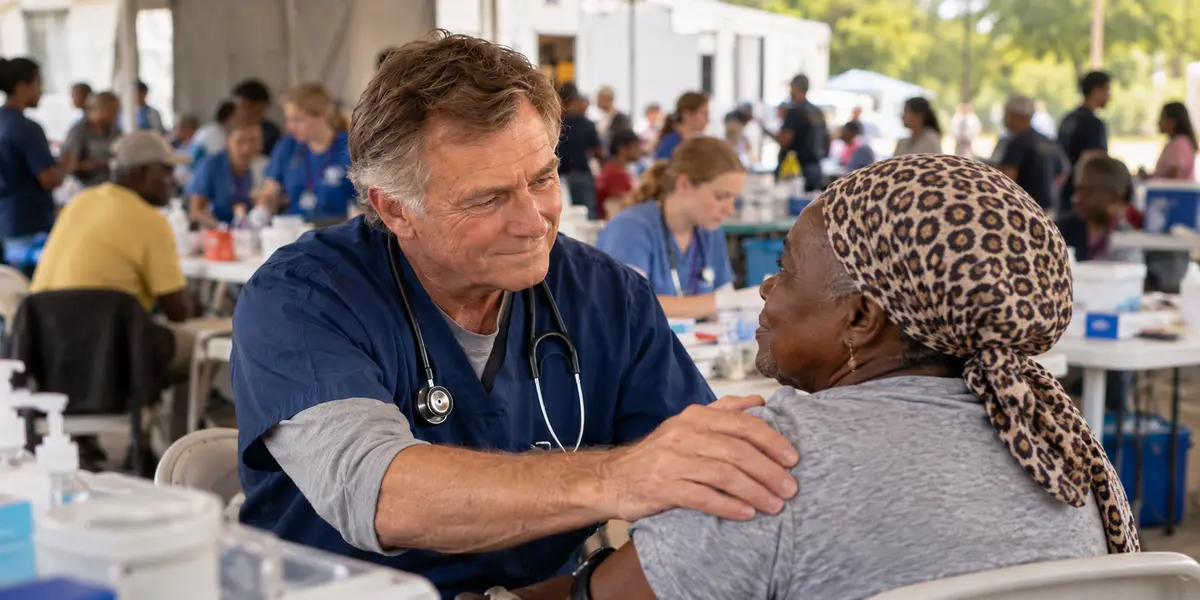
RAM’s first medical expedition took place in Santiago Ixcuintla, Mexico, where volunteer medical professionals provided free treatment to more than 1,000 patients. The organization brought together doctors, dentists, nurses, pilots, and other volunteers willing to donate their time and skills. They could set up a temporary clinic, treat patients over several days, and then transport the equipment to another community.
As RAM grew, portable dental equipment, medical supplies, and machines for eye examinations became part of its operations. The approach allowed small teams to provide services that would otherwise have required patients to travel long distances.
Brock had originally expected most of the work to happen in isolated parts of the developing world. But while operating from Tennessee, he discovered that Americans were facing a different version of the same problem.
He Found the Same Problem in America
For many people in the United States, getting to a doctor wasn’t difficult. Paying for the visit was.
Some were working people without health insurance. Others had insurance but still couldn’t afford dental treatment, eyeglasses, or medical procedures that weren’t fully covered.
In 1992, RAM held its first American clinic in Sneedville, Tennessee. The organization began expanding its work throughout Appalachia and eventually into communities across the country.
Patients could receive dental fillings, tooth extractions, eye examinations, prescription glasses, and general medical care without paying for treatment. As word spread, people began traveling considerable distances to attend the clinics, sometimes arriving the night before to secure a place in line.
Hundreds Were Still Waiting Outside
In 2008, CBS’s 60 Minutes visited one of Brock’s clinics in Knoxville, Tennessee. Volunteers were preparing to provide medical, dental, and vision care over a single weekend.
Patients began gathering before midnight, even though the doors wouldn’t open for another seven hours. Organizers handed out numbered tickets to manage the crowd.
By the end of the weekend, the volunteers had treated 920 patients. They had made 500 pairs of glasses, performed 94 mammograms, pulled more than 1,000 teeth, and completed hundreds of dental fillings.
But when the clinic closed, roughly 400 people were still waiting outside. During his interview with CBS correspondent Scott Pelley, Brock spoke about how difficult it was to turn people away when he knew they needed treatment.
He Worked to Bring More Doctors Across State Lines
Brock also tackled a legal obstacle that made organizing free clinics unnecessarily difficult. Doctors and dentists who wanted to volunteer sometimes faced licensing restrictions that prevented them from treating patients outside their home states.
He pushed for changes that would make it easier for qualified medical professionals to help. His efforts contributed to Tennessee’s Volunteer Health Care Services Act of 1995, which allowed eligible professionals licensed in other states to provide free treatment through charitable programs.
Brock continued running Remote Area Medical without taking a salary. He lived simply at the organization’s headquarters in Tennessee, where colleagues later recalled that he slept on a grass mat in the building.
He remained involved with RAM until his death on August 29, 2018, at age 82. By then, the organization had expanded far beyond its original overseas missions, with volunteer clinics operating across the United States.
The Clinics Kept Growing
Remote Area Medical continued operating after Brock’s death. By the end of 2024, the organization reported that nearly 230,000 volunteers had helped provide care to more than 977,000 people since its founding, delivering services valued at over $215 million.
That same year alone, RAM treated nearly 36,000 patients. The organization also began introducing equipment that could provide more complicated dental services during its temporary clinics.
In 2024, RAM introduced a mobile digital denture laboratory that uses 3D printing to make custom dentures. The entire laboratory fits inside a vehicle, allowing volunteers to bring it directly to a clinic.
Instead of requiring several appointments spread over weeks, the equipment can produce custom dentures in just a few hours.