Remarkable Stories
America Wouldn’t Let Him Fly — So He Became a Fighter Pilot for France
When the United States entered World War I in 1917, Eugene Bullard already had something the American military badly needed. He was a trained fighter pilot with experience flying for France.
Bullard was American, born and raised in Georgia. He wanted to serve his own country, so he applied to join the U.S. Air Service.
The Americans turned him down because he was Black. France, however, had already given him the opportunity to become one of the first Black combat pilots in military history. And his remarkable career was just getting started.
Leaving Georgia Behind
Eugene Bullard was born in Columbus, Georgia, in 1895. His father, William, had been enslaved, and Eugene grew up in a part of America where racial discrimination and violence were everyday realities.
At just 11 years old, he ran away from home. He spent several years making his way through the American South before finding an opportunity to leave the country altogether.
In 1912, Bullard secretly boarded a German freighter and crossed the Atlantic to Scotland. He eventually reached London, where he earned money boxing and performing with an African American entertainment troupe.
His boxing career took him to France in 1913, and he immediately noticed how differently people treated him there. In Paris, he could enter restaurants, socialize and move around without facing many of the restrictions he’d experienced growing up in Georgia.
Bullard decided France was where he wanted to build his life. But within a year, Europe would be at war.
From the Trenches to the Sky
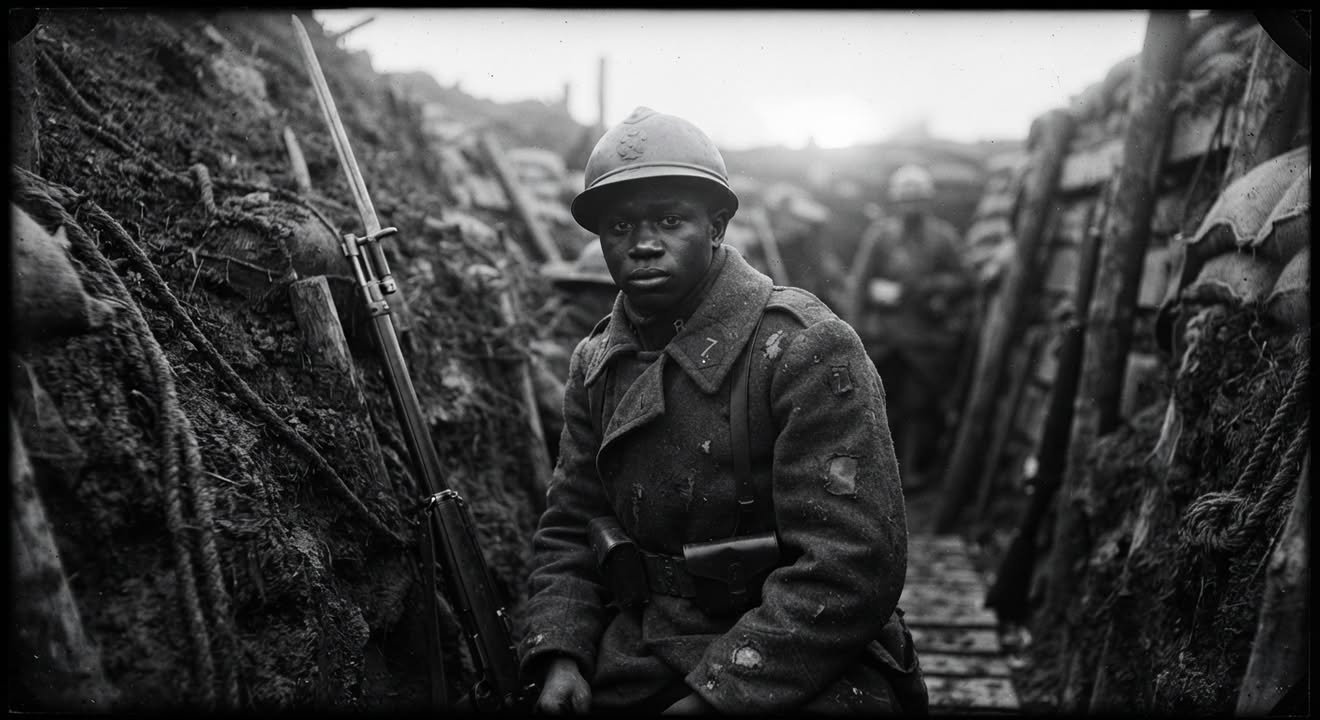
When World War I broke out in 1914, Bullard volunteered for the French Foreign Legion. He eventually served in the French infantry, fighting in some of the war’s most dangerous battles.
In 1916, he was seriously wounded during the Battle of Verdun, one of the bloodiest battles of the entire war. He survived and was sent away from the front to recover.
During his recovery, Bullard learned about opportunities to serve in French military aviation. Flying was still a relatively new part of warfare, and becoming a military pilot was an exciting prospect.
According to accounts of his life, Bullard even made a wager that he could get into the French flying service despite being Black. In November 1916, he joined the French military aviation program and began training at Tours. By May 1917, he had earned his pilot’s wings.
Bullard went on to fly with French fighter squadrons, including Escadrille Spa 93 and Spa 85. He became the first African American military pilot known to have flown in combat, taking to the skies over Europe while the war continued below.
His aircraft carried a heart-and-dagger insignia and became associated with the words All Blood Runs Red. Bullard also had an unusual companion during his flying career. He kept a rhesus monkey named Jimmy, who became his mascot and even appeared with him in photographs.
The Country That Wouldn’t Accept Him
When America joined the war in April 1917, Bullard saw an opportunity to transfer into the U.S. Air Service.
He was already flying combat missions for France. He had military training, experience under fire and the qualifications needed to handle an aircraft during wartime.
But the American military refused to accept him. An officer-rank requirement was given as the official explanation, although the Smithsonian National Air and Space Museum identifies racial prejudice within the American military as the reason behind his rejection.
Bullard remained with the French, serving the country that had allowed him to become a pilot in the first place. By the time he left military service after the war, he had accomplished something that the United States wouldn’t allow Black Americans to do in its own flying service.
A New Life in Paris
After World War I, Bullard returned to civilian life in Paris and became involved in the city’s growing nightlife scene. He owned a popular nightclub called Le Grand Duc, operated a bar named L’Escadrille and ran an athletic club. His businesses brought him into contact with some of the best-known entertainers and writers of the era.
Among the people who crossed his path were Langston Hughes, Josephine Baker and F. Scott Fitzgerald.
Bullard had built a successful life in France, but the peace didn’t last. As another war approached in the late 1930s, he became involved in intelligence work against Nazi sympathizers operating inside the country.
When World War II began, he served France again, this time as a machine gunner. He was wounded during the fighting and eventually escaped the German advance, traveling through Spain and Portugal before returning to the United States.
Back in America, his life looked very different. Despite his extraordinary military career, Bullard worked ordinary jobs in New York, including as a security guard and longshoreman. Most Americans had never heard of him.
France Never Forgot Him
Although Bullard received little recognition in America, the French government continued honoring his service.
In 1954, he was selected as one of three veterans to relight the eternal flame at the Tomb of the Unknown Soldier in Paris. It was one of France’s most important national memorials, honoring those who had died serving the country.
Five years later, in 1959, France made Bullard a knight of the Legion of Honor, its highest order of merit. By then, he had received 15 French military decorations recognizing his wartime service.
Bullard died in New York in 1961, at the age of 66. For decades afterward, his achievements remained largely unknown in the country where he had been born. That began to change in 1992, when the Smithsonian National Air and Space Museum added a bronze portrait of Bullard to its collection, helping introduce his story to a new generation of Americans.
Then, on September 14, 1994, the United States Air Force finally commissioned Eugene Bullard as a second lieutenant.
He had been dead for 33 years.