Remarkable Stories
Her Doctor Said She Would Never Walk Again. She Won Three Olympic Gold Medals
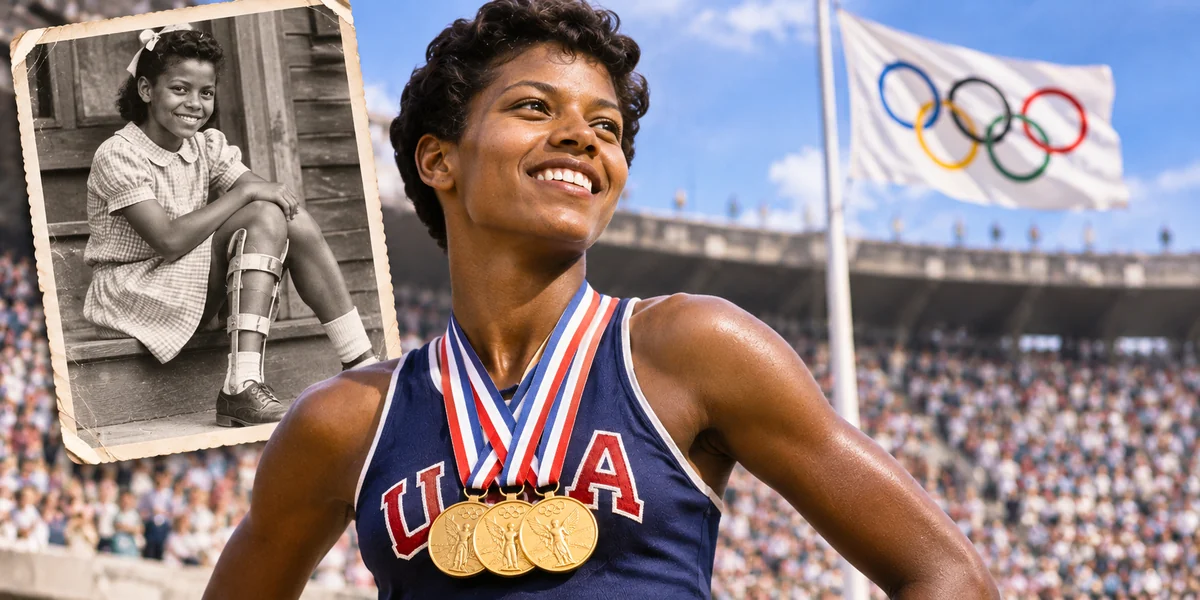
When Wilma Rudolph was a little girl, she had to wear a metal brace on her left leg just to get around. Polio had left the leg weak, and doctors weren’t optimistic about her chances of recovering. One doctor even told her family that she would never walk again.
Her mother, Blanche, had other ideas. She believed Wilma could recover, even if it meant years of treatment and hard work. And with a house full of children, she had plenty of people willing to help.
Wilma was born in Tennessee in 1940, one of 22 children in her father’s large family. She had suffered several serious illnesses during childhood, and getting proper medical treatment wasn’t easy. Hospitals in the segregated South often refused to treat Black patients, leaving her family with few options.
Her Mother Had Other Ideas
Blanche eventually found a hospital in Nashville that would treat her daughter, but it was about 50 miles from their home in Clarksville. She took Wilma on regular bus rides for treatment, sometimes spending hours travelling to appointments. Back at home, other family members helped with the exercises and massages recommended by her medical team.
Wilma’s brothers and sisters took turns massaging her leg, sometimes several times a day. It became part of the family’s routine, and everyone pitched in when they could. Gradually, Wilma grew stronger and began moving around with less help from the brace. By about age 11, she was running around and playing basketball with other children.
Basketball became her favourite activity, and she eventually joined the team at Burt High School in Clarksville. She was tall, quick, and fiercely competitive, although she wasn’t an overnight sensation. With practice, she became one of the school’s strongest players and developed a reputation for her speed.
That speed caught the attention of Ed Temple, the track coach at Tennessee State University. He invited Wilma to train with his athletes, a group of talented young women known as the Tigerbelles. She began learning the techniques of competitive sprinting, and Temple quickly recognized her potential.
Sixteen Years Old and Heading to the Olympics
In 1956, Wilma qualified for the American Olympic team while she was still a high school student. She was only 16 when she travelled to Melbourne, Australia, to compete against some of the fastest women in the world. It was her first experience competing internationally.
She entered the 200 metres but didn’t advance beyond the preliminary round. The American women’s 4 × 100-metre relay team did better, finishing third and earning bronze medals. Wilma returned to Tennessee with an Olympic medal before she had even finished high school.
Over the next few years, her life changed in several ways. She became a mother in 1958, giving birth to her daughter Yolanda while continuing her education and athletic career. She also kept training under Temple, determined to improve her sprinting before the next Olympics.
By 1960, Wilma had become one of America’s leading female sprinters. She was regularly competing against experienced international athletes and producing some of the fastest times in women’s track and field. When she qualified for the Olympic Games in Rome, she arrived as a serious contender for gold.
The Fastest Woman in Rome
Wilma entered the 100-metre final on September 3, 1960, with some of the best sprinters in the world lined up against her. She accelerated away from the pack and crossed the finish line in 11.0 seconds, winning her first gold medal. The strong following wind meant her time couldn’t count as a world record, but she had won the race comfortably.
Four days later, she returned to the track for the 200-metre final. She had already set an Olympic record during the preliminary rounds and followed it with another impressive performance in the final. Wilma won her second gold medal, becoming the first American woman to win both Olympic sprint events at the same Games.
One event remained, and this time she wasn’t running alone. The women’s 4 × 100-metre relay brought together Wilma and three teammates from Tennessee State’s Tigerbelles program. They had trained together for years, but the final against Germany, Poland, and other strong teams would be a difficult race.
The Americans were trailing Germany when Wilma received the baton for the final leg. Germany’s anchor runner, Jutta Heine, was ahead, leaving Wilma with ground to make up before the finish line. She zoomed down the straightaway, passed Heine, and brought the American team home in first place.
With that victory, Wilma became the first American woman to win three gold medals at a single Olympic Games. Reporters and fans celebrated her performances, and she became one of the biggest stars of the Rome Olympics. At just 20 years old, she had reached the top of international track and field.
She Had One Condition for Her Homecoming
When Wilma returned to Tennessee, her hometown of Clarksville wanted to celebrate its new Olympic champion. Organizers planned a parade and banquet in her honour, and the community was excited to welcome her home. But Wilma had a problem with how the events were being organized.
Clarksville was still a segregated city, and Black and white residents were often kept apart at public gatherings. Wilma had spent years representing her country, travelling internationally, and competing before enormous crowds. She wasn’t prepared to return home and accept a celebration that excluded people because of their race.
She told the organizers that she would participate only if the events were open to everyone. They agreed, and her homecoming became one of Clarksville’s first major racially integrated public celebrations. Thousands of people turned out to honour the woman who had brought three Olympic gold medals back to their city.
Wilma continued competing for a short time before retiring from track and field in 1962, while she was still in her early twenties. She finished her university education and later worked as a teacher, coach, and advocate for young athletes. She also established the Wilma Rudolph Foundation to support educational and athletic opportunities for children.
Wilma died in 1994 at the age of 54, she had spent the years after her Olympic victories helping other young people succeed. Her achievements brought international attention to women’s track and field when female athletes received far less recognition than they do today. She also used her public standing to challenge segregation and encourage opportunities for Black athletes.
When Clarksville offered Wilma a parade, she could easily have accepted the celebration exactly as it was planned. Instead, she insisted that everyone in her hometown should be welcome to take part.