Against the Odds
His Blood Helped Protect 2.4 Million Babies. He Was Afraid of Needles
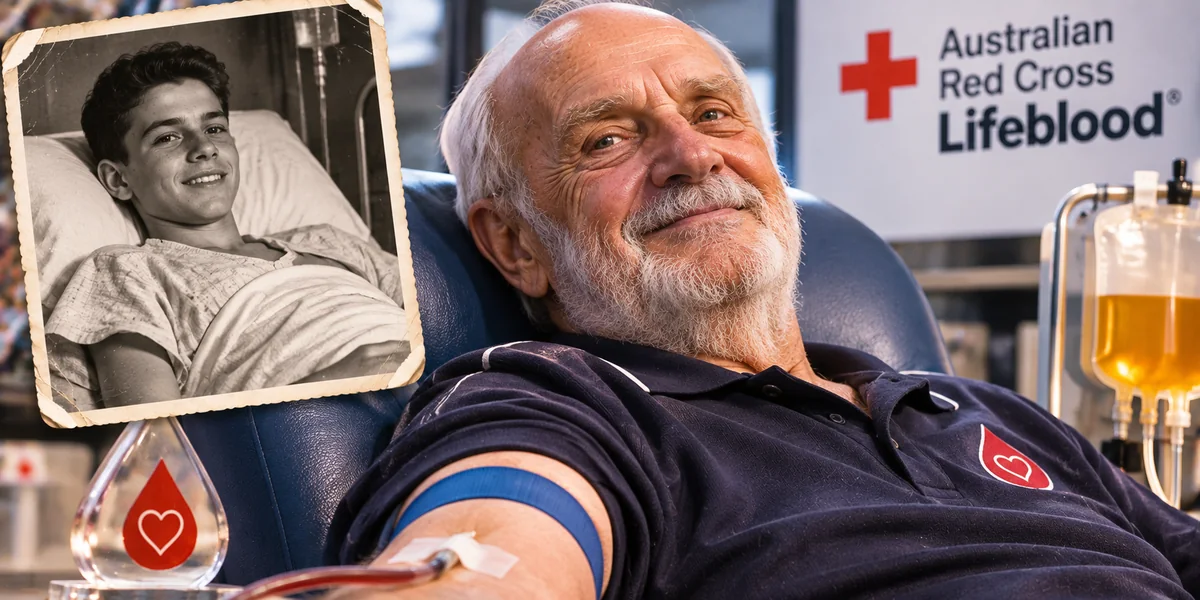
James Harrison hated needles, which was rather inconvenient considering how much time he spent at blood donation centres. Whenever a nurse prepared to jab one into his arm, he turned his head and looked somewhere else. Even after decades of donating, he never got used to that part.
He wasn’t someone who enjoyed medical appointments, and he certainly didn’t look forward to having a needle stuck in his arm. But he had a good reason for coming back, and it went all the way back to something that happened when he was a teenager. Without the generosity of strangers, he might not have lived long enough to become a donor himself.
A Promise He Made at Fourteen
In 1951, when James was 14 years old, he underwent major surgery to remove part of a lung. The operation was serious, and he needed numerous blood transfusions during his treatment. When he recovered, he learned that the blood donated by people he had never met had helped save his life.
His father was already a blood donor, and James decided he wanted to follow his example. He couldn’t donate immediately because he was too young, so he made himself a promise to start when he turned 18. In 1954, he kept that promise and made his first donation.
James continued donating while working and raising a family in Australia. He eventually became a railway clerk, leading a fairly ordinary life outside his visits to the blood service. As far as he knew, there was nothing unusual about his blood or any reason it would be more valuable than someone else’s.
Something Special in His Blood
During the 1960s, Australian doctors were working on a treatment for a serious problem that could affect babies during pregnancy. When a woman with Rh-negative blood carries a baby with Rh-positive blood, her immune system can sometimes produce antibodies against the baby’s red blood cells. Those antibodies can cause dangerous complications, especially during later pregnancies.
Researchers had discovered that a treatment called anti-D could prevent many of these problems. It worked by stopping the mother’s immune system from developing the harmful response in the first place. The difficulty was finding enough suitable antibodies to make the medication available to everyone who needed it.
When scientists examined James’s blood, they discovered something unusual. His plasma contained high levels of the particular antibodies needed to produce anti-D injections. Researchers believed the transfusions he received as a teenager might have played a role, although the exact reason wasn’t certain.
The blood service invited James to join its anti-D program, and he agreed. Instead of continuing with ordinary whole-blood donations, he began giving plasma, the liquid part of blood that contains the useful antibodies. His donations could now help prevent serious illness in babies before they were even born.
Australia began using anti-D treatment in the late 1960s, and the results changed maternity care. Pregnant women who faced blood incompatibility could receive injections to help protect their babies. James was one of a relatively small group of donors whose plasma helped make that treatment possible.
The Man With the Golden Arm
James began donating plasma regularly, often returning to the blood centre every two weeks. During these appointments, equipment collected his plasma while returning other blood components to his body. The process allowed him to donate more frequently than someone giving whole blood.
He preferred using his right arm and became a familiar face to the nurses who handled his appointments. They knew about his dislike of needles, so they weren’t surprised when he turned away while they got everything ready. Once the needle was in place, he was happy enough to talk and pass the time.
His unusual contribution eventually earned him the nickname “The Man With the Golden Arm.” It was a fitting name for someone whose plasma was helping produce medication used in hospitals around the country. James, however, never seemed especially interested in making a fuss about himself.
He received the Medal of the Order of Australia in 1999 in recognition of his service. By then, he had already spent decades donating and had become an important part of the country’s anti-D program. He continued making appointments because he knew hospitals still needed the antibodies his blood contained.
There was also a personal reason the program meant so much to him. His daughter, Tracey Mellowship, received anti-D treatment during pregnancy, just as many other Australian mothers had. The medication he helped produce was now protecting pregnancies within his own family.
His Final Donation
By 2018, James was 81 years old and had been donating for more than six decades. Australian blood service rules meant he had reached the age when he would have to stop, even though he would gladly have continued. On May 11, he arrived at a Sydney donation centre for his final appointment.
It was his 1,173rd donation, an astonishing total for someone who had never liked needles in the first place. Australian Red Cross Lifeblood estimated that his plasma had contributed to anti-D treatment protecting approximately 2.4 million babies. That figure represented the reach of the treatment program, rather than a literal count of children who would otherwise have died.
James had mixed feelings about retiring because he knew his plasma was still useful. He encouraged other people to consider donating and said he hoped someone would eventually break his record. As far as he was concerned, having more people willing to give blood was a much better outcome than keeping the record forever.
The anti-D program continued after his retirement, but finding suitable donors remained a challenge. Only a small number of people have the antibodies needed to produce the medication. Researchers were also exploring ways to manufacture anti-D antibodies in laboratories, which could eventually make supplies less dependent on individual donors.
James died peacefully in his sleep on February 17, 2025, at the age of 88. His years of donating had earned him international recognition, but he had spent most of that time simply turning up for appointments and giving what he could. The Australian blood service remembered him as one of its most dedicated donors.
At his final appointment, several mothers brought their babies to the donation centre to meet him. James enjoyed talking with the families while the nurses prepared for his last donation. And when it was time for the needle, he still looked the other way.