Remarkable Stories
The Giant Rat Who Helped Clear Landmines From Cambodia
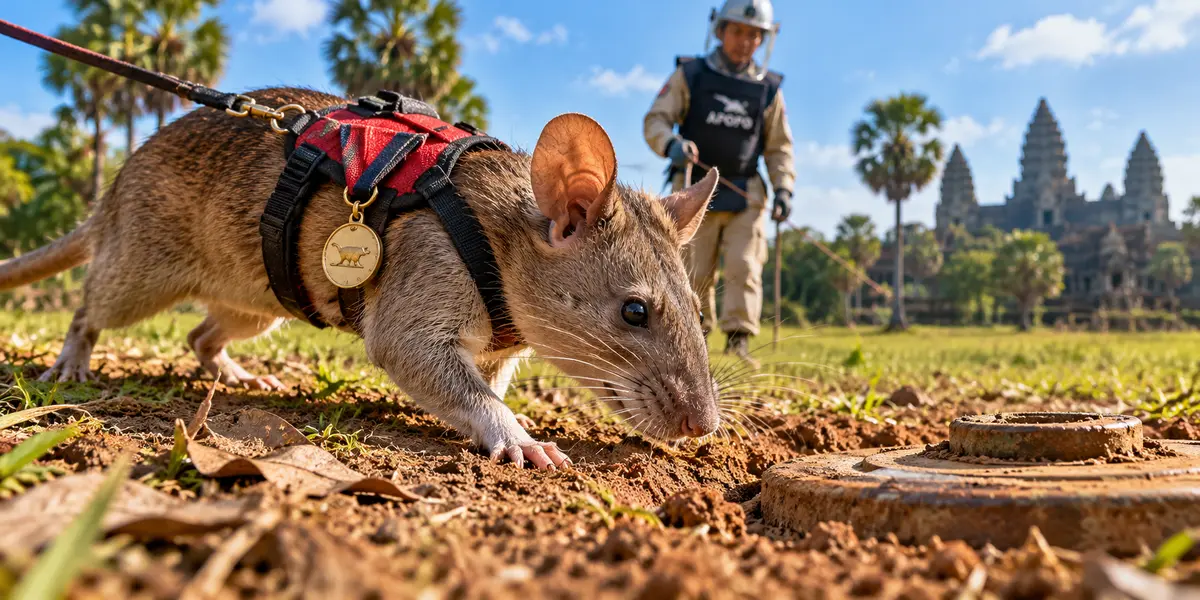
In Cambodia, one of the most successful landmine detectors didn't wear heavy protective equipment or carry an expensive metal detector. He had four paws, enormous ears and a nose that could find explosives hidden beneath the ground. He also worked for food.
His name was Magawa, and he was an African giant pouched rat. He was much larger than an ordinary pet rat, but still light enough to walk across minefields without setting off the explosives he was searching for. That made him an ideal candidate for a job that had challenged mine-clearance teams for decades.
Cambodia had been left with enormous numbers of buried landmines and unexploded weapons after years of conflict. Long after the fighting ended, families were still living near dangerous fields and paths. Farmers couldn't use their land safely, and children could encounter hidden explosives while playing outside.
Finding all those buried weapons was difficult, expensive and slow. Metal detectors could pick up harmless scraps of metal alongside dangerous objects, leaving specialists with plenty of ground to investigate. Magawa had been trained to search for something more specific.
A Very Different Kind of Training
Magawa was born in Tanzania and raised at a training centre run by APOPO, a Belgian nonprofit organization that teaches animals to detect explosives and diseases. The centre operates at Sokoine University of Agriculture, where young rats begin learning how to work with people.
The training starts when the rats are still tiny. Handlers introduce them to people, unfamiliar sounds and different surroundings until they feel comfortable. Once they're ready, the rats learn that the sound of a clicker means they've earned a food reward.
Next comes learning to recognize TNT, an explosive found in many landmines. When a rat identifies the correct scent, it hears the click and receives something tasty. Trainers gradually introduce other smells so the animal learns which ones to ignore.
Eventually, the rats begin searching through soil in outdoor training areas. They wear small harnesses and learn to scratch at the ground when they detect the scent of explosives. That scratching tells their handlers where to look.
Before working in a real minefield, each rat has to pass a demanding test. APOPO requires the animal to locate all the target mines in a 400-square-metre training area while making no more than one false indication. Magawa completed his training and was sent to Cambodia in 2016.
Small Paws, an Incredible Nose
In the field, Magawa worked alongside trained handlers who guided him through carefully marked search areas. When he detected explosives, he scratched the ground to show where something might be buried. Human specialists then investigated the spot and safely removed or destroyed whatever they found.
Unlike a metal detector, Magawa could recognize the smell of explosives without being distracted by every old nail or piece of scrap metal. That saved clearance teams time, allowing them to concentrate on places where dangerous objects were more likely to be hidden.
Over his five-year career, Magawa detected 71 landmines and 38 other pieces of unexploded ordnance. His work helped clear more than 141,000 square metres of land, an area roughly equivalent to 20 football fields.
A Gold Medal for a Rat
In September 2020, the British veterinary charity PDSA awarded Magawa its Gold Medal for his life-saving work. He became the first rat ever to receive a PDSA medal, joining a distinguished group of animals that includes dogs, horses, pigeons and a cat.
The medal was even made small enough for him to wear. His work also earned him a Guinness World Record for the most landmines detected by a rat at that time, making him one of the most celebrated animals in mine-clearance history.
By 2021, though, Magawa was getting older. His handlers noticed that he was slowing down, and APOPO decided it was time for him to retire. His longtime handler, Malen, had worked alongside him for years and was proud of everything they'd accomplished.
Magawa retired in June 2021 and spent his remaining months resting and playing instead of searching minefields. He died peacefully in January 2022, at the age of eight, leaving behind an impressive record and a team of people who had cared for him throughout his career.
A Statue for an Unusual Hero
On April 3, 2026, Cambodian officials gathered in Siem Reap to unveil a monument dedicated to Magawa. Four years after his death, the little rat was receiving an honour that very few animals ever experience.
Standing 2.2 metres tall, the stone statue shows Magawa wearing his working harness and medal. Cambodian artisans carved the monument, which stands near APOPO's visitor centre, not far from the famous Angkor Wat temple complex.
The base contains fragments of decommissioned explosives, connecting the monument to the work Magawa spent years doing. Senior Minister Ly Thuch attended the unveiling alongside mine-clearance representatives, local officials and students.
The ceremony also recognized the people who trained and worked with Magawa. Those handlers and clearance specialists had spent years turning his discoveries into land that families could safely use again.
APOPO continues training HeroRATs, and visitors to its centre can learn how these animals help locate hidden explosives.
His rewards were usually small treats.
The families he helped received something much bigger.