Remarkable Stories
He Helped Thousands See Again With a $4 Eye Lens
Sanduk Ruit grew up in a remote Himalayan village in eastern Nepal, where reaching the nearest school meant walking for nearly a week. Getting medical treatment was even more difficult.
When he was 17, his older sister died of tuberculosis. It was a devastating loss, especially because the disease could be treated if someone received medical attention in time.
Years later, Ruit became an eye surgeon. He wanted to help people who were losing their sight simply because they couldn’t afford treatment or lived too far from a hospital.
Meeting a Doctor Who Shared His Vision
During the 1980s, Ruit was working on a survey of blindness in Nepal when he met Australian eye surgeon Fred Hollows. The two doctors were troubled by the same problem. Thousands of people were living with cataracts, a condition that clouds the eye’s natural lens and can eventually cause blindness.
The surgery to restore their vision already existed. But in poorer countries, patients often had their cloudy lenses removed and were given thick glasses afterward because implanting artificial replacement lenses was considered too expensive. Ruit and Hollows believed there was no reason patients in Nepal should receive a lesser standard of treatment.
In 1987 and 1988, Ruit trained with Hollows in Australia, learning modern surgical techniques that used artificial lenses. When he returned to Nepal, he was determined to make those procedures available to people who had little hope of receiving them.
Taking the Operating Room Into the Mountains
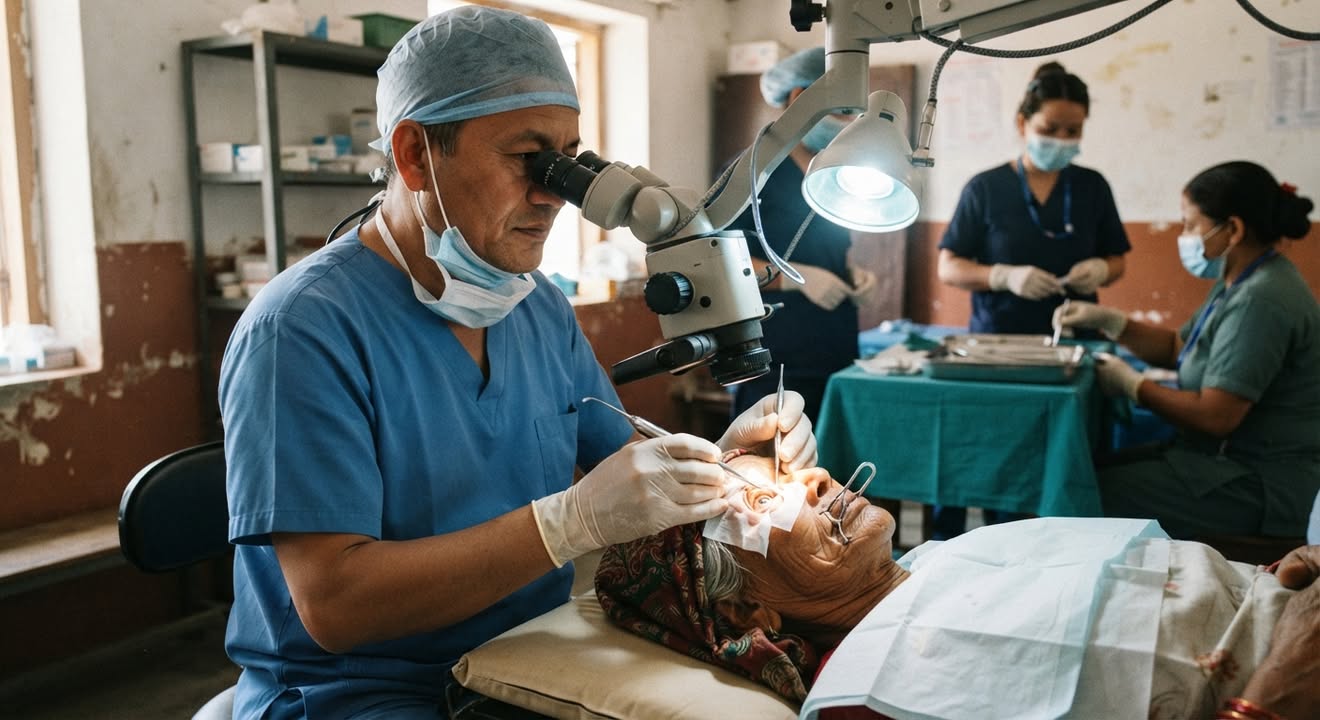
Ruit refined a technique that allowed surgeons to remove cataracts and implant artificial lenses through a small incision, often without needing stitches. The operation itself could take just minutes.
He began organizing surgical clinics in remote communities, bringing portable medical equipment and trained teams to places that rarely received specialist care. Some patients arrived after long journeys, guided by relatives because their eyesight had deteriorated so badly.
The temporary clinics allowed large numbers of people to receive treatment close to home. Ruit eventually became known for performing dozens of cataract operations in a single day, sometimes approaching 100.
But there was still one major obstacle he needed to overcome.
The Tiny Lens That Cost Too Much
The artificial lenses used in cataract surgery could cost around $100 each. For families living on very little money, that price alone could make an operation impossible. Ruit and Hollows set out to change that.
In 1994, the Tilganga Eye Centre opened in Kathmandu, helping establish a new approach to affordable eye care. An associated manufacturing laboratory began producing high-quality artificial lenses locally.
According to Ruit’s account to the Ramon Magsaysay Award Foundation, lenses that once cost about $100 could eventually be produced for approximately $4. That enormous price reduction changed what hospitals and outreach programs could afford to provide.
Instead of relying on expensive imported supplies, medical teams could perform modern cataract surgery at a fraction of the previous cost. Tilganga also began training surgeons and other eye-care workers, allowing hospitals in other countries to adopt the same techniques.
Restoring Sight to Thousands
Ruit’s work eventually expanded far beyond Nepal. Medical professionals traveled to Tilganga for training, affordable lenses were supplied internationally, and surgical teams brought treatment to communities across Asia and Africa.
In June 2006, Ruit and his team traveled to North Korea for a six-day surgical campaign. During that visit, they restored sight to more than 1,000 people.
The project demonstrated how much could be accomplished when skilled surgeons, affordable equipment and carefully organized medical teams worked together. That same year, Ruit received the Ramon Magsaysay Award for Peace and International Understanding, recognizing his efforts to make effective cataract treatment accessible to people who otherwise might remain blind.
By then, his work had grown into something much larger than his own surgical practice.
Hospitals were adopting his methods, local doctors were receiving training, and thousands of patients were getting treatment that once seemed completely out of reach.