Changing Lives
He Couldn’t Afford School — So He Built a Windmill From Scrap
William Kamkwamba was just 14 years old when his family could no longer afford to send him to school. Malawi was suffering through a devastating famine, his family was struggling to find enough food, and paying school fees had become impossible.
Instead of attending classes, William spent his days helping his family and looking for ways to continue learning. One place he could still go was a small local library.
William loved science, especially anything involving electricity and machines. Although his English wasn’t particularly strong, he borrowed books and studied the illustrations, trying to understand how things worked. Then, one afternoon, he came across a picture that would change his life.
It showed a windmill generating electricity. William looked at the diagram and began wondering whether he could build something similar. His family’s home had no electricity, and he knew how useful it would be to have lights, power a radio, and eventually find a way to pump water.
There was one fairly significant problem. He had almost no money, no engineering equipment, and no proper workshop. But there was a scrapyard nearby.
Building a Windmill From Junk
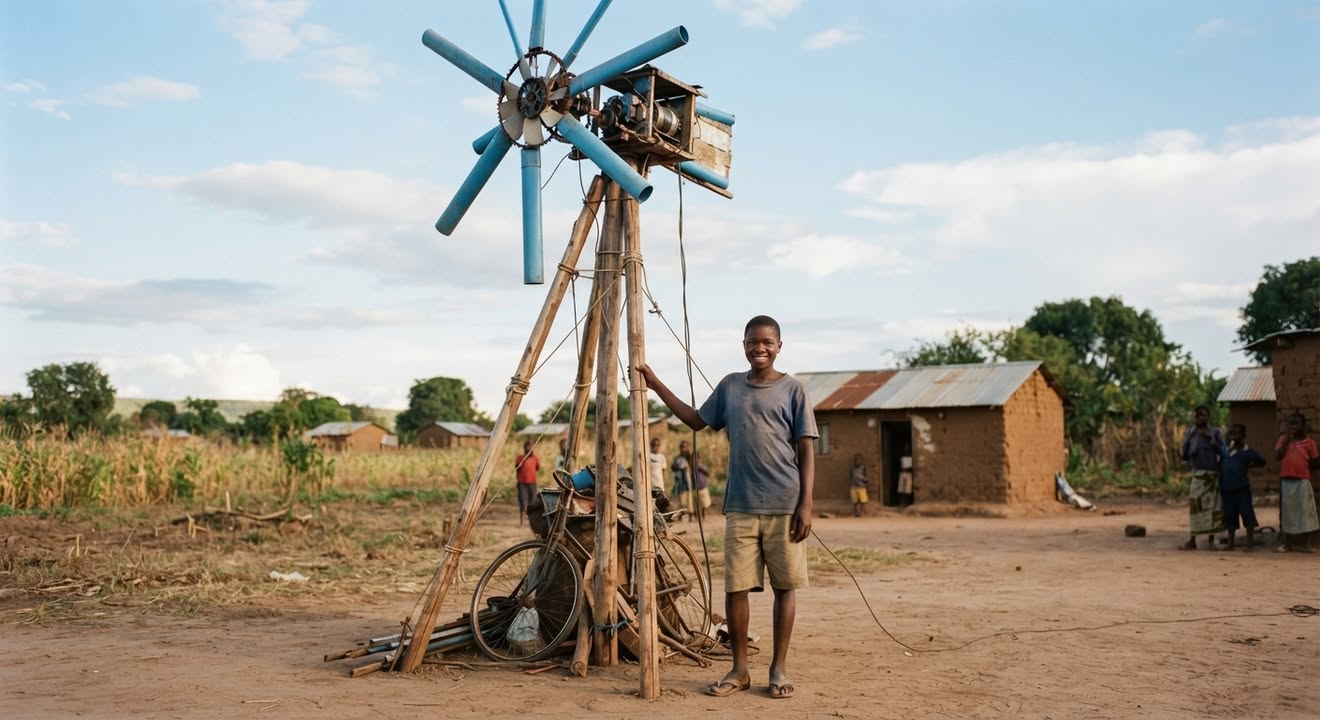
William began collecting anything that looked useful. He searched through discarded machinery, old bicycle parts, pieces of PVC pipe, and other materials people had thrown away. He found parts that could be turned into blades, supports, and mechanical connections.
Among the pieces he used were a bicycle frame and an old tractor fan. A friend also helped him obtain a bicycle dynamo, a small generator that William couldn’t afford to buy himself.
He studied the diagrams from a library book called Using Energy, figuring out how moving blades could turn a generator and produce electricity. The work was difficult, especially because William was teaching himself nearly everything as he went along. When something didn’t fit or work properly, he had to find another piece of scrap or come up with a different solution.
His neighbors didn’t know what to make of it. People watched him carrying home strange pieces of metal and plastic, then assembling them into a large structure in the yard. Some laughed at him, and others thought he was wasting his time.
Even his mother wondered why he kept dragging junk home. William continued working anyway.
Eventually, he had assembled a windmill tall enough to catch the breeze, with homemade blades connected to the salvaged generator. He was finally ready to find out whether the idea he’d discovered in that library book would work.
The First Light Came On
When the wind caught the blades, the windmill began turning. The spinning blades drove the generator, producing enough electricity to power a light bulb.
William had done it. Using discarded parts and information he had taught himself from books, a teenager who couldn’t afford school had built a functioning wind-powered electrical system. For a family that had lived without electricity, even one light was a major improvement.
William continued making changes to his invention. He added more lights, switches, and a circuit breaker, improving the system as he learned more about electricity. Eventually, his windmill was powering four lights and two radios in the family home.
His neighbors began looking at the strange structure quite differently. People who had laughed while he was building it were now coming over to see how it worked. Some even lined up at his house to charge their mobile phones.
William had suddenly become the person in the village who knew how to make electricity. But he was already thinking about what else he could build.
He wanted to develop larger machines capable of pumping water, helping farmers irrigate their crops when rainfall was unreliable. In a country where drought and hunger had affected so many families, that possibility was particularly exciting.
From a Village in Malawi to the World Stage
For several years, William’s windmill was mainly a local curiosity. Then a newspaper published a story about the young inventor. The article eventually appeared online, where it attracted the attention of people involved with the TED conferences.
In 2007, TEDGlobal conference director Emeka Okafor travelled to William’s village in Malawi to meet him. William was invited to speak at TEDGlobal in Arusha, Tanzania.
The opportunity was almost unbelievable for a young man who had spent much of his life in a rural village. Before that trip, William had never flown in an airplane, stayed in a hotel, or even travelled outside Malawi. He had never used the internet.
His English was still limited, so his first appearance onstage was brief. But when people saw photographs of his windmill and heard what he had accomplished, they were fascinated.
The audience included entrepreneurs, engineers, educators, and people who wanted to help him continue his education. Support began arriving from around the world.
William was finally able to return to school, and funding helped him improve the electrical system at his family’s home. He eventually attended the African Leadership Academy before continuing his education in the United States.
In 2014, William graduated from Dartmouth College with a degree in environmental studies. The teenager who had been forced to leave school because his family couldn’t afford the fees had become a university graduate.
The Boy Who Harnessed the Wind
William’s experience eventually became the subject of a book, The Boy Who Harnessed the Wind, which he wrote with journalist Bryan Mealer. The memoir became a bestseller and was later adapted into a feature film, introducing his story to audiences around the world.
But William wasn’t finished building things. He continued working on projects connected to electricity, clean water, agriculture, and technology in Malawi.
His organization, Moving Windmills, began focusing on helping communities develop practical solutions to local problems. Projects connected to his work have included solar-powered systems, irrigation, and machinery built from recycled materials.
He also became interested in helping young people who reminded him of himself. Through Moving Windmills, William has been developing an innovation center in Kasungu, Malawi. The idea is to create a place where young inventors can learn practical skills, use equipment, receive guidance, and experiment with their own ideas.
His work has also expanded into technologies such as electric motorcycles and machines for processing maize.
A Workshop for the Next Generation
William understands what it’s like to have an idea without the money or equipment to build it. When he was 14, he had to search through piles of discarded machinery and rely on a friend to help him get a small generator.
He had no engineering teacher standing beside him, explaining how to assemble everything. He learned from diagrams, trial and error, and the determination to keep working until the blades finally turned.
Now he’s helping create something he could only have dreamed of as a teenager: a place where young people can walk through the doors, find tools and equipment, and get help building the inventions they’ve been thinking about.