Remarkable Stories
He Built a 97-Block Safety Net for Kids
Growing up in the South Bronx, Geoffrey Canada knew what it felt like to be afraid in his own neighborhood. Children could be attacked walking down the street, and fights were so common that learning how to protect yourself became part of growing up.
His father had left the family when Geoffrey was just four years old, leaving his mother to raise the children on her own. As he got older, Canada watched boys he’d grown up with end up in prison or lose their lives to violence. He eventually made it out of the neighborhood, but he never forgot the children who hadn’t been as fortunate.
Years later, he would return to New York with an ambitious idea: build an entire neighborhood where children could get the support they needed to succeed.
He Knew What These Kids Were Facing
Canada worked hard at school and eventually earned a place at Bowdoin College in Maine. He graduated in 1974 and went on to earn a master’s degree in education from Harvard the following year.
With those qualifications, he had plenty of career opportunities. But he wanted to work with children growing up in communities like the one he’d known.
He began working with young people in New York and eventually joined Rheedlen Centers for Children and Families, an organization that helped children and families facing difficult circumstances. By 1990, Canada was running the organization.
At first, much of the work involved familiar youth programs. Children could get tutoring, take part in activities and spend time in places where adults looked out for them.
The programs helped, but Canada kept noticing a problem. A child might receive excellent support at school, then go home to a family struggling with money, unstable housing or a dangerous neighborhood.
And children who fell behind before kindergarten could spend years trying to catch up. Canada began to believe that helping children succeed meant supporting their families and neighborhoods, too.
Building Something Bigger Than a School
Instead of opening another individual program, Canada wanted to create a network of services that families could rely on throughout their children’s lives.
The idea was to begin helping parents before their children entered school, then continue providing support through elementary school, high school, college and eventually into their careers. Families would have access to educational programs, health services, parenting support and other resources in the same community.
The organization began experimenting with this approach on a single block in Harlem during the 1990s. Rather than sending families from one agency to another, the program tried to connect the services they needed. Parents could receive guidance while their children attended programs designed to help them learn and develop.
In 1997, the larger effort began taking shape as the Harlem Children’s Zone. Canada wanted to see whether providing that level of support to an entire neighborhood could help more children build successful futures.
From One Block to 97
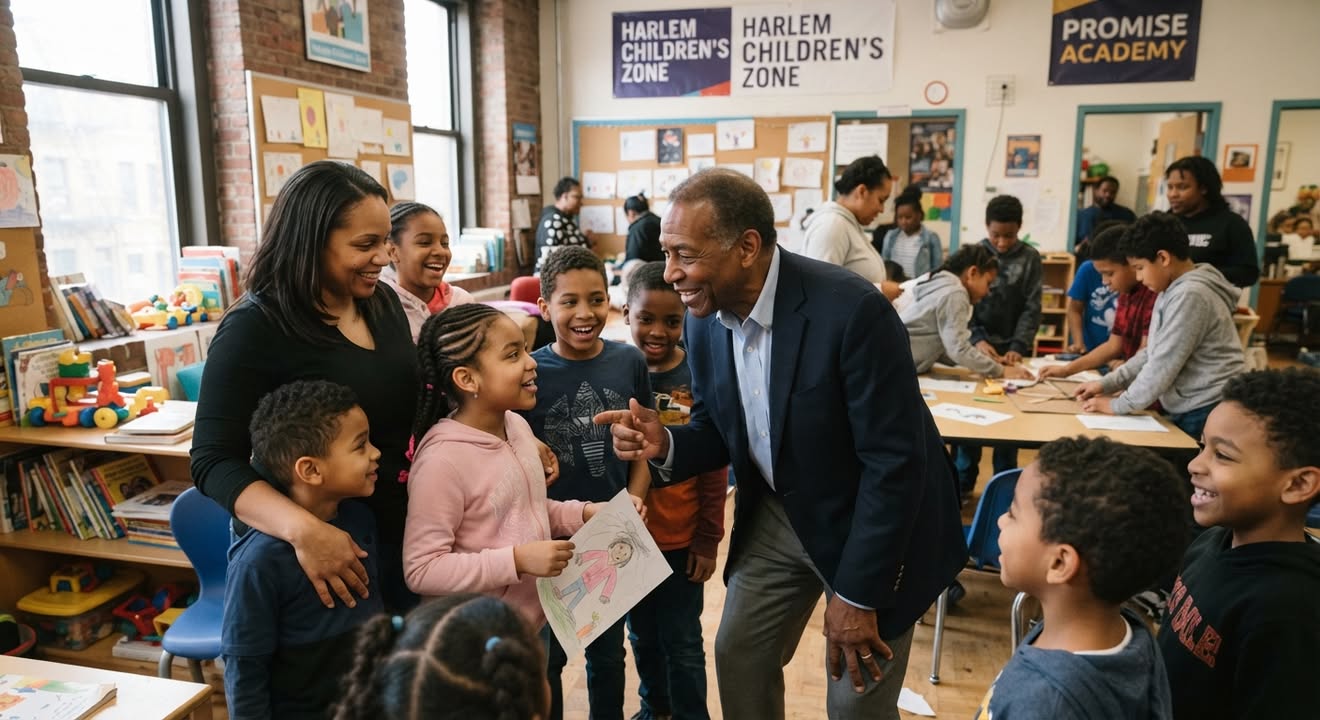
The project expanded as Canada and his team developed more programs. What began as an experiment on one block grew into an area covering 24 blocks, then 60, and eventually 97 blocks of Central Harlem. The Harlem Children’s Zone included early-childhood programs, charter schools, after-school activities, health initiatives, family services and support for students preparing for college.
Some programs worked with parents of babies and toddlers. Others helped teenagers with schoolwork, college applications and planning for careers.
The organization also addressed problems affecting the wider community, including violence and the difficulties families faced when trying to find stable housing or medical care. Thousands of children and families were now connected to a network that could offer help at different stages of their lives.
For Canada, the goal was to make those opportunities available throughout the neighborhood, rather than limiting them to the relatively small number of children an individual program could accommodate.
Other Communities Started Paying Attention
As the Harlem Children’s Zone grew, educators and community leaders around the country began studying its approach. Canada’s work attracted attention because it brought together services that were often provided separately. Schools, health programs, families and community organizations could work toward the same goal instead of operating independently.
In 2010, the Obama administration launched the Promise Neighborhoods initiative, inspired partly by the Harlem Children’s Zone. The federal initiative encouraged communities across the United States to develop similar programs, connecting educational opportunities with support for children and families. The experiment Canada had started in Harlem was now influencing programs far beyond New York.
Still Looking Out for the Next Generation
By then, Canada had spent decades working to give children opportunities he wished more of his childhood friends had received. He had also shown that support didn’t need to end after one school year or when a child reached a particular age. The Harlem Children’s Zone could remain involved as students grew older, helping them prepare for college and the years that followed.
In 2014, Canada stepped down as the organization’s chief executive, although he continued supporting its work. The organization kept growing, eventually reporting that its broader programs served more than 34,000 students and families.
And Canada wasn’t finished with it, either.
After stepping down as chief executive, he remained involved and later returned as president of the Harlem Children’s Zone.