Changing Lives
A School Had Almost No Books, So He Came Back With 3,000
In 1998, Microsoft executive John Wood was hiking through Nepal when a local headmaster invited him to visit his school. Wood accepted, expecting a brief look around before continuing his trek through the Himalayas. What he found stayed with him long after the trip ended.
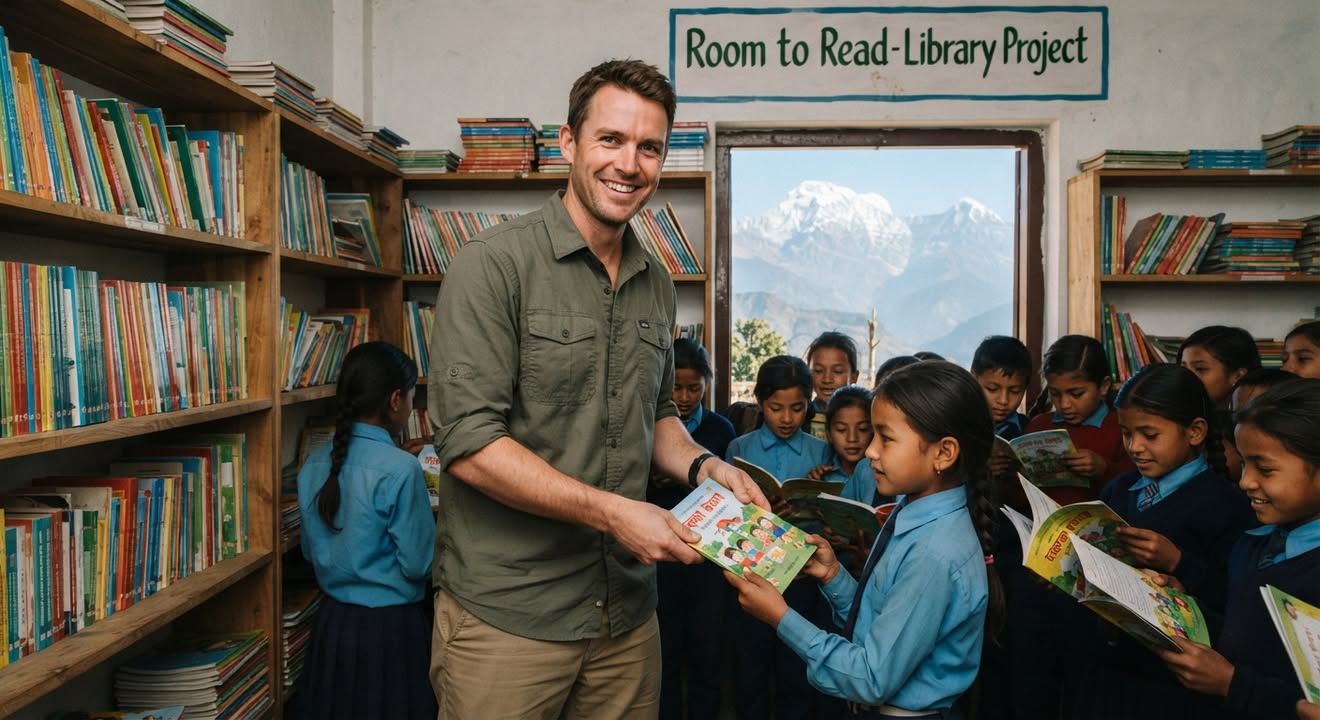
The school had approximately 450 students, but its library was practically empty. Around 20 books were kept inside a locked cabinet, most of them left behind by travelers. The children had almost nothing to read outside their school lessons.
Wood was stunned. He had spent years working in international technology, surrounded by computers, information, and opportunities. Here was a school full of children who barely had access to books.
Before he left, the headmaster made a simple request. “Perhaps, sir, you will someday come back with books.”
Wood promised he would.
A Promise That Became 3,000 Books
At the time, Wood was 35 years old and working as Microsoft’s director of business development for Greater China. He had a successful career, a comfortable income, and the kind of job that took him around the world.
But after returning from Nepal, he couldn’t stop thinking about that little school. Wood began emailing friends, relatives, and coworkers, asking whether they had children’s books they could donate. The response surprised him. People started sending books, and the collection grew far beyond anything he had expected.
His father helped organize donations, including boxes arriving at the family home in Colorado. Within the first month, Wood had collected approximately 3,000 books. There was still the rather large problem of getting them to a remote school in the Nepalese mountains.
Wood teamed up with Dinesh Shrestha, a Nepali education advocate who understood the local challenges. Together, they worked through the difficulties of moving donated books into Nepal and getting them to the communities that needed them.
In 1999, Wood returned to the school, keeping his promise to the headmaster. The books made the final stretch of their journey on the backs of six donkeys.
The children were thrilled. Many had never seen brightly colored children’s books like the ones arriving that day. They crowded around the new arrivals, eager to see what was inside.
Wood had originally planned to help one school. After seeing the children’s excitement, he began thinking about how many other schools might be in exactly the same situation.
Walking Away From Microsoft
Returning to his job was harder than Wood expected. He had spent years helping Microsoft expand into international markets, building teams and developing businesses. He knew how much could be accomplished when people had a clear goal and the resources to pursue it.
Now he was thinking about schools instead of software. The idea of leaving Microsoft was a serious decision. Wood had worked hard to build his career, and starting an education charity meant giving up his income and much of the security he had earned.
But he had also discovered something he genuinely wanted to spend his life doing. Wood left Microsoft in 1999. The following year, he joined Shrestha and Erin Ganju to establish the organization that became Room to Read.
They started in Nepal, helping communities establish libraries and improve school facilities. Rather than simply collecting books and dropping them off, the organization began working directly with local communities to create places where children could develop reading skills.
Wood brought his business experience into the organization. He concentrated on attracting donors, building reliable teams, measuring results, and developing a system that could expand into new countries. Room to Read gradually moved beyond Nepal, opening programs in Vietnam, Cambodia, India, Laos, and other countries.
More Than Shelves Full of Books
As the organization grew, its team discovered that providing books was only part of the work. In many communities, children needed reading material in their own languages. Schools also needed trained teachers, suitable lessons, and better ways to help young students learn to read.
Room to Read began working with local writers, illustrators, and publishers to create children’s books specifically for the communities it served.
These weren’t simply old books collected from somewhere else. They were new stories written for children in their own languages, often featuring places, families, and experiences they would recognize. The organization also developed reading programs that included teacher training, classroom materials, and support for children who were struggling.
According to Room to Read, students in its literacy programs have read up to 2.5 times as fast and answered up to 2.6 times as many comprehension questions as students in comparison schools. Another part of the organization’s work focused on girls whose education was at risk of ending early.
Poverty, family responsibilities, and pressure to marry young could make continuing school difficult. Room to Read developed programs offering mentorship, practical life skills, and support for girls as they made decisions about their education and futures.
By the end of 2025, the organization reported that approximately 4.5 million adolescents had benefited from its gender-equality programs.
From One School to Millions of Children
The organization that began with a single request in Nepal eventually grew into an international education operation. By the end of 2025, Room to Read reported reaching 29 countries and benefiting approximately 60.4 million children since its founding. During 2025 alone, its programs benefited around 17 million children.
It had also invested more than $1 billion in global education. John Wood eventually stepped away from running Room to Read, but the organization continued growing under new leadership. Local educators, writers, community groups, and government partners now carry out much of the work.
The books themselves have come a long way, too. Room to Read reports distributing more than 46 million children’s books and publishing 5,225 original and adapted titles, many created in partnership with local authors and illustrators. Wood later remembered something else about that first delivery in Nepal.
Teachers from neighboring villages had heard that a man was arriving with books. Some had walked four, five, or even six hours just to be there.
They hadn’t come to collect books for themselves.
They wanted to ask whether he could visit their schools next.