
Against the Odds
More Than 20 Companies Rejected His Invention — It Became Xerox
In October 1938, Chester Carlson stood in a tiny makeshift laboratory in Queens, New York, staring at a piece of wax paper. Something extraordinary had just happened.
He and his assistant had successfully copied an image without using photographic chemicals. It was a rough experiment involving a metal plate, sulfur, electricity, and powder, but Carlson believed it could change the way offices worked. He was right.
There was just one problem: almost nobody wanted his invention. Over the next several years, Carlson would approach more than 20 companies, including some of America’s biggest technology manufacturers. Every one of them turned him down.
An Idea Born From Frustration
Carlson worked in the patent business, where copying documents was part of everyday life. Patent applications involved technical drawings, specifications, and paperwork that frequently needed to be duplicated.
In the 1930s, making those copies wasn’t particularly convenient. Existing methods could be slow, expensive, or dependent on photographic chemicals. Carlson figured there had to be a better way.
He began reading about static electricity and materials that reacted to light. Eventually, he developed an idea for transferring an image using electrical charges and a fine powder. He started experimenting in his spare time, often working with homemade equipment in his apartment.
Things didn’t always go smoothly. One experiment involved heating sulfur on his kitchen stove. It caught fire and filled the apartment building with a terrible smell, much to his wife’s displeasure.
Carlson eventually rented a small workspace behind a beauty salon in Astoria, Queens. The room had previously been used as a janitor’s closet. He also hired Otto Kornei, an unemployed physicist who had recently arrived in America.
Together, they continued experimenting, and on October 22, 1938, they finally succeeded. They coated a small zinc plate with sulfur, charged its surface using static electricity, and exposed it to light through a glass slide containing handwritten words.
When they dusted the plate with powder, the writing appeared. Carlson pressed wax paper against the image and transferred the powder onto it. He was holding the world’s first xerographic copy.
Twenty Companies Said No
Carlson knew his experiment was only the beginning. The process worked, but turning it into something ordinary office workers could use would require serious engineering and money. He needed a company willing to develop it.
Beginning in 1939, he started approaching manufacturers with demonstrations of his invention. IBM wasn’t interested. Neither were General Electric, Eastman Kodak, or RCA.
The refusals kept coming. By 1944, more than 20 companies had rejected his proposal.
Part of the problem was the demonstration itself. Carlson could show executives a crude image produced on a tiny metal plate, but he couldn’t hand them a finished copying machine.
The companies were being asked to invest in a technology that still needed years of development. They also had to believe businesses would want a different way to make copies.
Carlson was discouraged. At times, he considered giving up, but he kept returning to the invention because he believed it could work. After years of rejection, he finally found someone willing to listen.
Someone Finally Took a Chance
In 1944, Carlson approached the Battelle Memorial Institute, a research organization in Columbus, Ohio. He demonstrated his copying process to a group of scientists and engineers. The results were still rough, but one engineer, Russell Dayton, recognized how unusual the technology was.
For the first time, Carlson was talking to people who could see a reason to develop his idea. Battelle agreed to support the research.
The initial investment was just $3,000, and some of the institute’s own scientists remained doubtful. But it was enough to begin improving the materials and equipment. Three years later, another opportunity appeared.
The Haloid Company, a small manufacturer of photographic paper in Rochester, New York, was looking for a way to expand beyond its existing business. Its president, Joseph Wilson, became interested in Carlson’s technology.
In 1947, Haloid signed an agreement with Battelle to develop the process into a commercial product. Carlson received $2,500 from the initial licensing arrangement. It was the first money he’d earned from an invention he had been promoting for nearly a decade.
The First Machine Was a Headache
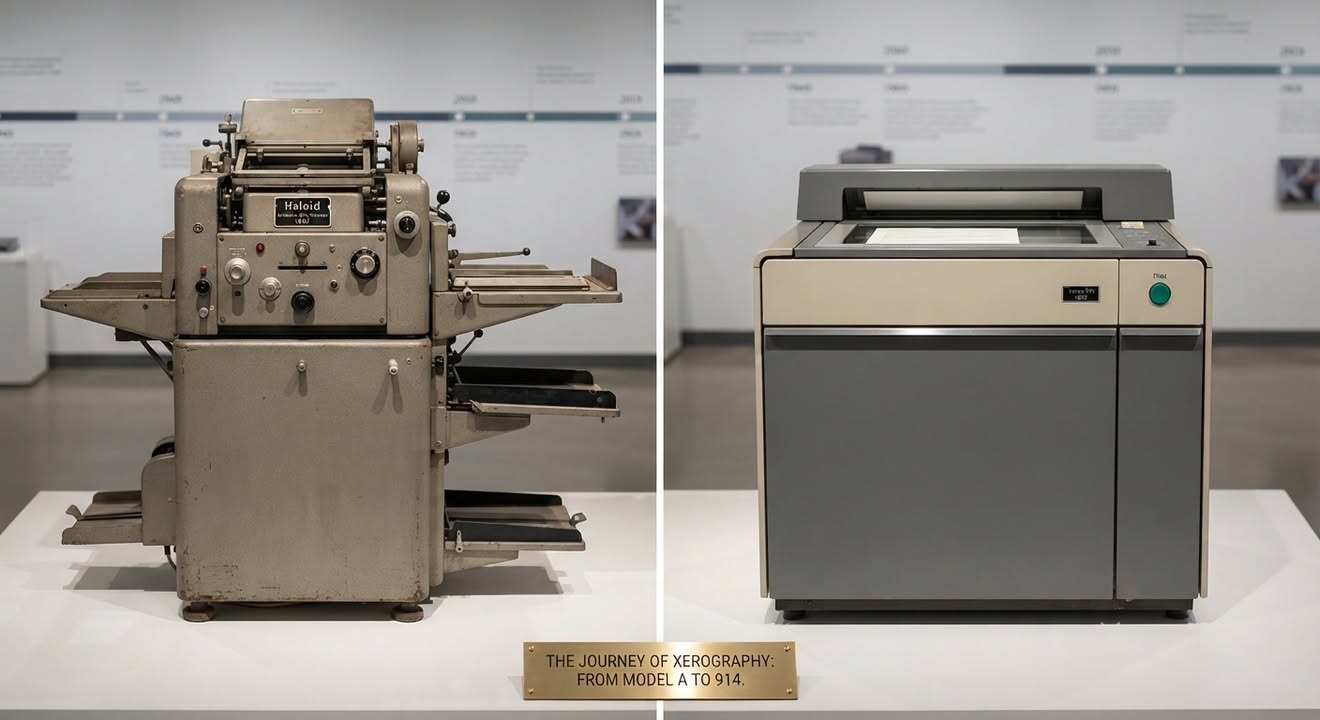
Haloid introduced its first commercial xerographic copier, the Model A, in 1949. Unfortunately, using it was a complicated business.
Making a copy involved numerous separate steps. Operators had to handle the equipment carefully, and even experienced users couldn’t produce copies particularly quickly. It was a long way from the simple machine Carlson imagined.
The Model A found some specialized uses, particularly in preparing printing masters, but it wasn’t ready to transform the average office. Haloid kept investing anyway.
Its engineers spent the following decade improving the electrical systems, developing better toner, and finding ways to move ordinary paper through the machine automatically. The process also received a new name.
Instead of the complicated scientific term electrophotography, it became known as xerography, from Greek words meaning dry writing. Haloid began using Xerox as a product name.
And in 1959, more than 20 years after Carlson’s first successful experiment, the company finally introduced the machine he’d been hoping someone would build.
The Machine That Changed Offices
The Xerox 914 looked and worked very differently from the Model A. An office worker could place a document on the glass, press a button, and receive a permanent copy on ordinary paper.
There were no messy photographic chemicals to handle, and the process was fast enough for everyday office use. The machine was introduced in September 1959, and the first production unit was delivered to a customer in March 1960.
Demand quickly exceeded expectations. Businesses began producing far more copies than Haloid had predicted. Some customers were running their machines thousands of times a day.
The company had spent years wondering whether anyone would want the technology. Now it was struggling to keep up with how much people wanted to use it.
The Xerox 914 became a tremendous commercial success, and Haloid eventually renamed itself Xerox Corporation. Carlson became a wealthy man through the invention he’d spent so many years trying to sell.
But he didn’t keep most of his fortune. Despite his wealth, he continued living relatively simply and gave away nearly $100 million to charitable organizations before his death in 1968.
He also donated materials from his early experiments to the Smithsonian Institution. Among them was the original glass slide that Otto Kornei had used during that first successful experiment in the tiny Astoria laboratory.
It was still carrying the same handwritten words: 10-22-38 ASTORIA.