Remarkable Stories
Strangers Stopped on a South Dakota Road to Save an Owl Tangled in Barbed Wire
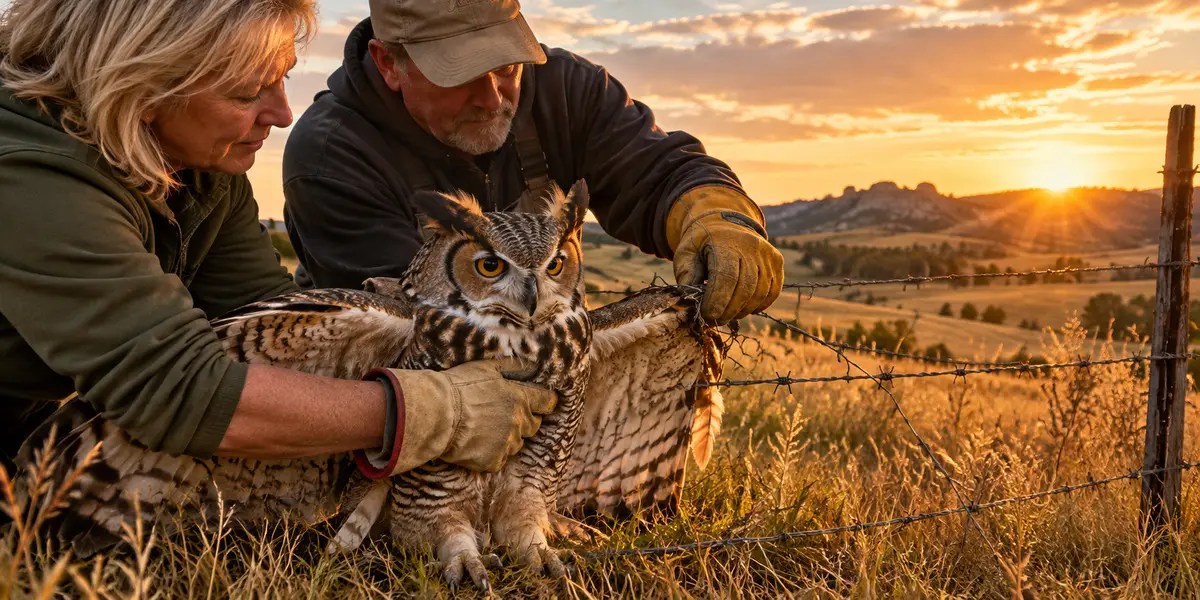
Scott Jacobs was driving near Spearfish, South Dakota, when he noticed something hanging from a barbed-wire fence beside the road. It looked like a dead hawk, and he mentioned it to his wife, Sharon, as they drove past.
Sharon immediately told him to turn around. She’d rescued horses, cats, and dogs before, and she wasn’t about to leave an injured animal without checking whether it could be helped.
When Scott stopped, Sharon hurried down the dirt road toward the fence. She was wearing shiny silver high heels, hardly the ideal footwear for an animal rescue, but she was more concerned about the bird.
As she got closer, she realized Scott had been mistaken about two things. It wasn’t a hawk, and it wasn’t dead.
It was a great horned owl, and it was very much alive.
The Owl Was Tangled in the Fence
The couple had been heading to an employee meeting at their art gallery in Deadwood on October 1, 2026. They owned an art gallery and brewery there, and the stop beside the road had been completely unplanned.
The owl was caught in several strands of barbed wire, with its feathers blowing in the wind. Sharon approached carefully, trying to see how badly it was trapped.
Suddenly, the bird turned its head and stared directly at her. It began clicking its beak, warning her to keep her distance.
Sharon had worked with frightened rescue horses, so she started speaking softly to the owl in much the same way. She wanted it to stay calm while she figured out how to free it.
She called Scott over and asked him to bring gloves and something they could use to cover the bird’s head. They had a large grocery bag in their vehicle, which could help keep the owl calm during the rescue.
But they didn’t have any gloves. And getting close to the powerful claws of a frightened great horned owl without protection was a dangerous idea.
Another Driver Had Exactly What They Needed
While Sharon and Scott were trying to figure out what to do, another vehicle pulled over. The driver was a man named Brandon, a shift manager at a business called Lucky’s.
He asked what was happening, and Scott explained that an owl was trapped in the fence. Then he asked Brandon whether he happened to have a pair of gloves.
He did. The three approached the owl, carefully placing the grocery bag over its head and part of its wing. The bird remained surprisingly calm while they examined the twisted wire.
They quickly realized they might have to cut part of the fence to free it. But the wire belonged to someone else, and they needed permission before cutting through it.
Just then, another vehicle arrived. The woman driving was the landowner’s daughter. Sharon explained what had happened, and the woman called her father to ask whether they could cut the fence. He immediately agreed.
Now they needed wire cutters. As luck would have it, Brandon had those in his vehicle too.
They Finally Got the Owl Free
Scott put on the gloves and began working with Brandon to loosen the barbed wire. The owl had become so tangled that simply pulling it away was impossible.
As they worked, Scott managed to free one of the bird’s feet. Then something unexpected happened. The owl placed its other foot directly onto his gloved hand.
With Brandon’s help, Scott carefully released the remaining wire. Brandon removed his sweatshirt so they could cover the bird and keep it calm. Scott gathered the owl against his chest, holding its powerful feet securely with one hand and supporting its body with the other.
They had freed it, but there was no telling how badly it had been injured. Its wings and legs had been twisted into the fence, and the barbs could have caused serious damage.
Sharon had already called her veterinarian, who agreed to meet them at his clinic. The couple placed the owl inside an animal carrier they’d brought from home and drove straight there.
The Veterinarian Found More Barbed Wire
At the clinic, the veterinarian took the owl into an examination room while Sharon and Scott waited. A few minutes later, he returned holding a piece of barbed wire roughly a foot long. Two of its sharp points were covered in blood.
Somehow, the owl had survived being tangled in the fence without any apparent broken bones. The veterinarian believed it had become more tightly trapped as it struggled to escape.
The examination was encouraging, but the bird needed specialist care before anyone could know whether it would be able to fly again. Sharon began making phone calls, contacting South Dakota wildlife authorities and local organizations that might be able to help.
Eventually, arrangements were made to transfer the owl to the Black Hills Raptor Center, where experienced wildlife rehabilitators could treat its injuries.
Its Wing Had Escaped Serious Damage
At the raptor center, specialists examined the owl’s injured wing and found something encouraging. The thin membrane along the leading edge, an important part of a bird’s ability to fly, hadn’t been torn.
That was especially good news considering how tightly the owl had been tangled in the wire. The staff began treating it with pain medication and antibiotics while monitoring its recovery.
The center’s director, Maggie Engler, was cautiously hopeful that the bird would heal well enough to return to the wild. Sharon was delighted to hear that the plan was to release the owl near the same area where it had been found, provided it recovered sufficiently.
She immediately asked whether she could be there when it happened.
Seven Years Earlier, She Couldn’t Save Another Owl
For Sharon, the rescue was particularly emotional because she’d had another encounter with a great horned owl seven years earlier. During a powerful storm in the Black Hills, an owl had been perched on the peak of her garage roof when lightning struck it. The bird died instantly.
Sharon was heartbroken. She contacted a Lakota friend for advice about how to lay the bird to rest and eventually buried it on her property, keeping the location private.
She never forgot that owl. For years, she’d remembered finding it on the roof and knowing there was nothing she could do to help.
Now, seven years later, another great horned owl had crossed her path. This one had survived, thanks to a handful of strangers who stopped along a country road, shared what they had, and worked together to free it.
Sharon said she expected to cry if she got to watch the bird return to the wild. Seven years earlier, she’d buried an owl she couldn’t save.
This time, she hoped to be standing nearby when one flew away.