Remarkable Stories
Nobody Wanted His Helicopter — So He Built It at Home
Frank Robinson had spent years trying to persuade helicopter manufacturers to build a smaller, less expensive machine. He believed there were customers who wanted to fly helicopters but could not afford the aircraft already available.
His employers weren’t convinced. In 1973, he left Hughes Helicopters and started his own company, using his California home as its first address.
Robinson was 43. He put a drafting table in his living room and began designing the helicopter he had been unable to persuade anyone else to make.
He Knew the Industry From the Inside
Robinson had worked for companies including Cessna, McCulloch, Kaman, Bell and Hughes. His experience included helicopter development and specialized work on tail rotors.
He understood why helicopters were complicated and expensive. They had to lift their own weight, remain controllable in flight and be practical to maintain, all while carrying people safely.
But he believed a simpler, lightweight design could serve a market that larger manufacturers were overlooking. Flight schools, private owners and businesses doing light work did not always need a large aircraft.
On June 20, 1973, he founded Robinson Helicopter Company. The first aircraft would be the R22, a compact helicopter with two seats and a piston engine.
The Drawings Became a Flying Prototype
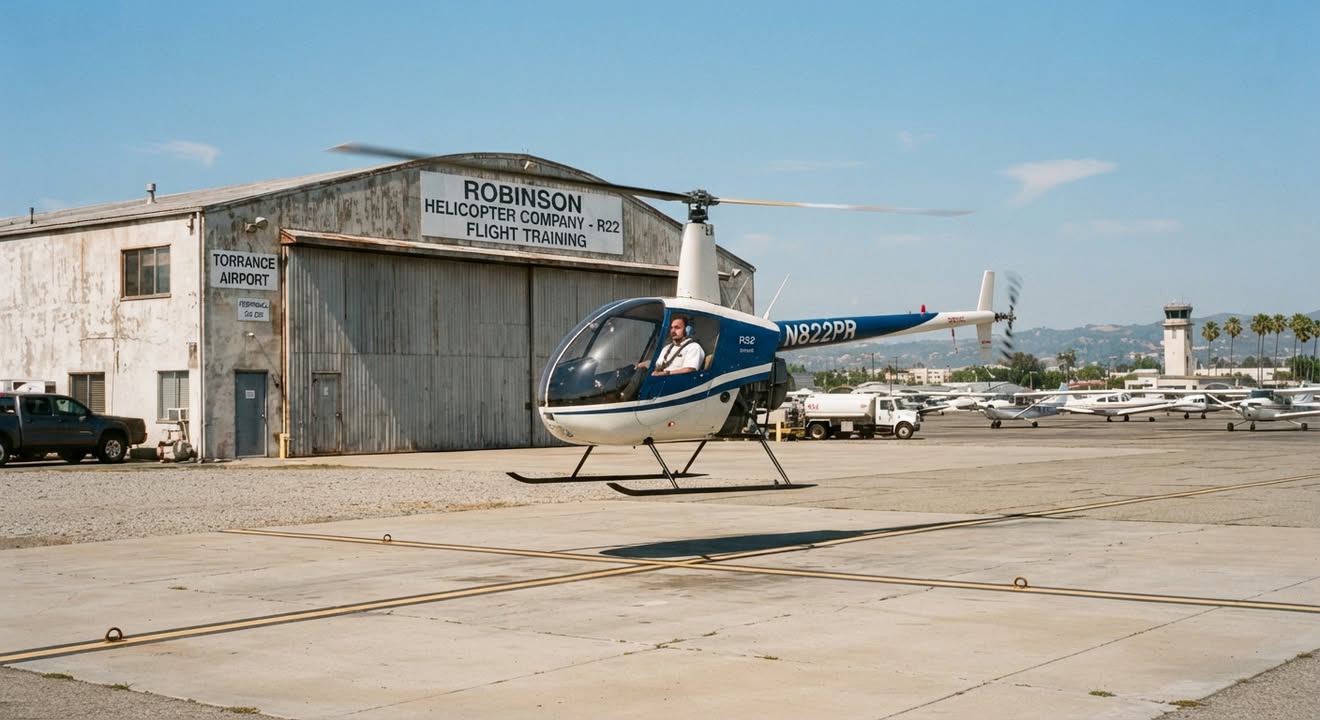
The work moved from Robinson’s home to a hangar at Torrance Airport, south of Los Angeles. There, the small company built the prototype that would test whether his ideas worked in the air.
On August 28, 1975, the R22 lifted off for the first time. Robinson flew it himself.
The flight was an important step, but the machine still had years of development ahead. A prototype that could fly was not yet an aircraft that customers could buy and operate.
In December that year, the first prototype was substantially damaged during a hard landing. Testing continued with a second aircraft rather than ending the program.
The company had to complete the engineering work, flight testing and documentation required for Federal Aviation Administration approval. The R22 received its type certificate in March 1979, almost six years after Robinson had started the business.
Customers Finally Got Their Turn to Decide
The first production R22 was delivered later in 1979. Robinson could now put his argument to a more useful audience than another employer: people deciding which helicopter to buy.
That first production R22 later entered the Smithsonian National Air and Space Museum’s collection. It remains the oldest surviving example of the aircraft.
The aircraft’s relatively low purchase and operating costs made it attractive for flight training. A two-seat machine could carry an instructor and student without requiring them to pay for the capacity of a much larger helicopter.
The company grew around that demand. By the end of the 1980s, Robinson had become a leading manufacturer of light civilian helicopters.
He then developed a larger aircraft. The four-seat R44 arrived in 1992, giving customers more room while retaining his emphasis on a practical, relatively economical design.
The business that had begun at home now had more than one aircraft serving the market he had spent years trying to explain.
The Little Helicopter Stayed in Service
Robinson retired in 2010 at age 80. Two years later, he received the Daniel Guggenheim Medal, an aviation honor recognizing his work in designing and manufacturing affordable, versatile helicopters.
He died in November 2022 at 92. The company continued building in Torrance, and the R22 remained part of its product line.
In August 2025, the aircraft reached the 50th anniversary of its first flight.
By then, nearly 5,000 R22s had been produced, and flight schools around the world were still using them to teach new pilots.