Animal Stories
The Dolphin Who Showed Two Stranded Whales the Way Home
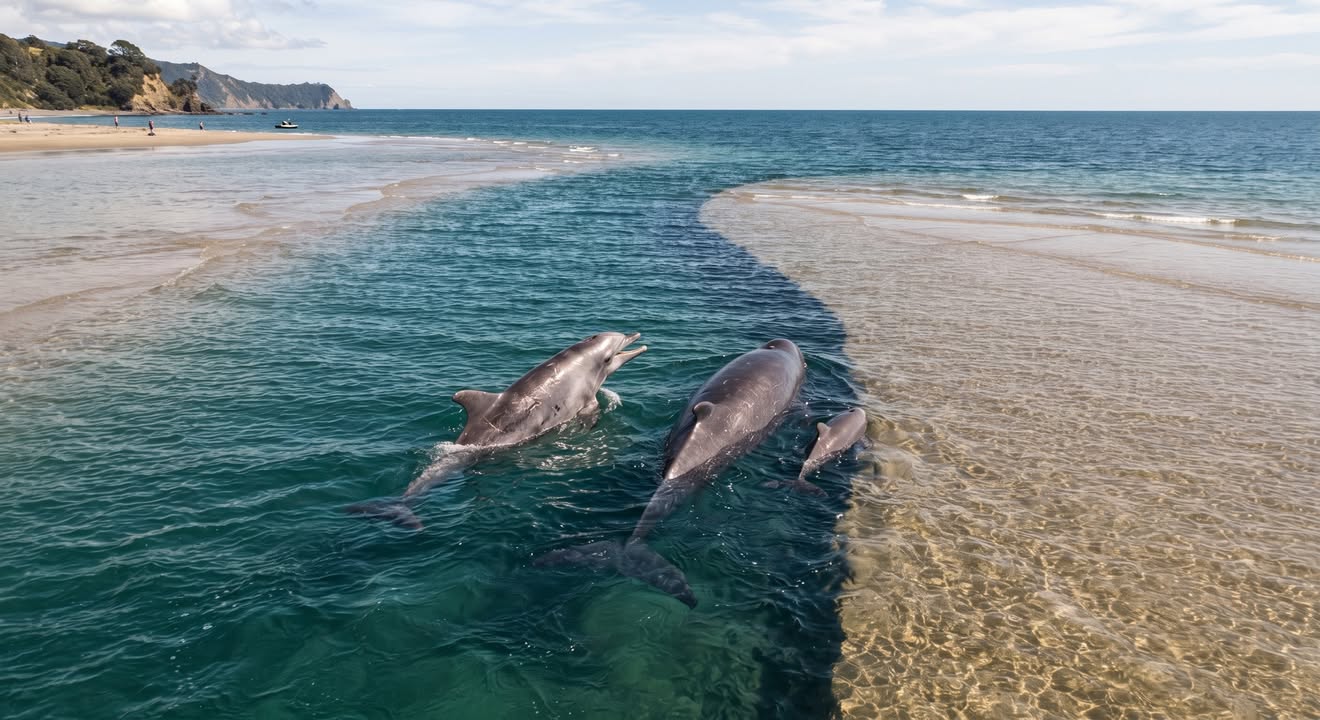
For nearly 90 minutes, Malcolm Smith had been trying to save two whales stranded on a beach in New Zealand. Every time he helped them back into the water, they turned around and ended up on the beach again.
The whales were a mother and her young calf, and both were becoming exhausted. Smith, a conservation officer, was getting cold and tired himself. He was running out of ideas when a dolphin named Moko appeared in the shallow water nearby.
What happened next surprised everyone watching.
The Whales Couldn’t Find Their Way Out
It was March 10, 2008, at Mahia Beach on the eastern coast of New Zealand’s North Island. A local resident had spotted the stranded whales early that morning and contacted Smith, who lived nearby.
The mother was a pygmy sperm whale approximately three metres long. Her male calf was about half her size, and neither seemed able to find its way back to deeper water.
Smith and several helpers repeatedly guided the pair away from the beach. But a large sandbar sat just offshore, blocking the easiest route to the open sea.
Each time the whales moved away from shore, they became confused and eventually returned to shallow water. Smith estimated that he had tried two or three times over an hour and a half, without getting them safely past the obstruction.
It was becoming a serious situation. Stranded whales can quickly become exhausted, and Smith knew from experience that even animals successfully returned to the water sometimes beach themselves again.
He was beginning to consider whether the whales would have to be put down to prevent further suffering. Then Moko arrived.
The Dolphin Everyone Knew
Moko was a young bottlenose dolphin who had been visiting Mahia since 2007. Unlike most wild dolphins, Moko regularly approached swimmers, kayakers, and people playing in the surf.
Locals had grown accustomed to seeing the dolphin following boats, playing with floating objects, and pushing kayaks around with his nose. Visitors sometimes came to the beach hoping for a chance to meet him.
Moko seemed especially interested in whatever people were doing in the water. So when the dolphin approached the rescue attempt, Smith wasn’t particularly surprised to see him.
What surprised him was how Moko behaved around the whales. The dolphin swam directly toward the stranded pair. Smith could hear noises coming from the animals.
The whales had been distressed and unwilling to move away from the beach. As Moko approached, they slipped beneath the surface and began following him.
Two Hundred Metres Made the Difference
Instead of leading the whales straight toward open water, Moko started swimming parallel to the shoreline. The mother and calf followed.
Together, the three animals moved approximately 200 metres along the edge of the sandbar. Then Moko made a sharp turn through a narrow channel that opened toward deeper water.
The whales followed the dolphin through the same channel and continued out to sea. It was the route Smith and the other rescuers had been struggling to help them find for the past 90 minutes.
Smith later told reporters that Moko had accomplished in just a few minutes what the human rescuers had been unable to do. The whales were never seen stranded on that beach again.
Back to Business as Usual
After the whales disappeared into deeper water, Moko didn’t follow them out to sea. The dolphin returned to the beach, where people were swimming and playing in the surf.
Smith was delighted. He had spent years working with stranded marine animals and had never witnessed anything quite like it. He later told reporters that he had gone into the water and given Moko a pat after the rescue, even though conservation workers generally discouraged people from touching wild dolphins.
Moko continued visiting Mahia and became one of New Zealand’s most famous marine animals. The dolphin eventually moved farther north along the coastline, where people continued reporting his playful encounters with swimmers and boats.
In July 2010, Moko was found dead on Matakana Island. The cause was never established, and hundreds of people attended a farewell ceremony for the dolphin who had become such a familiar part of their lives.
Moko was buried on the island, with local Māori communities taking part in the ceremony. Arrangements were also made to exchange sand between Matakana Island and Mahia, connecting Moko’s resting place with the beach where he had become famous.
And at Mahia, people still had the story of the morning when two stranded whales couldn’t find their way home, until a friendly dolphin showed them the route.