Remarkable Stories
He Trained Grandmothers to Become Solar Engineers. They Lit Up Villages
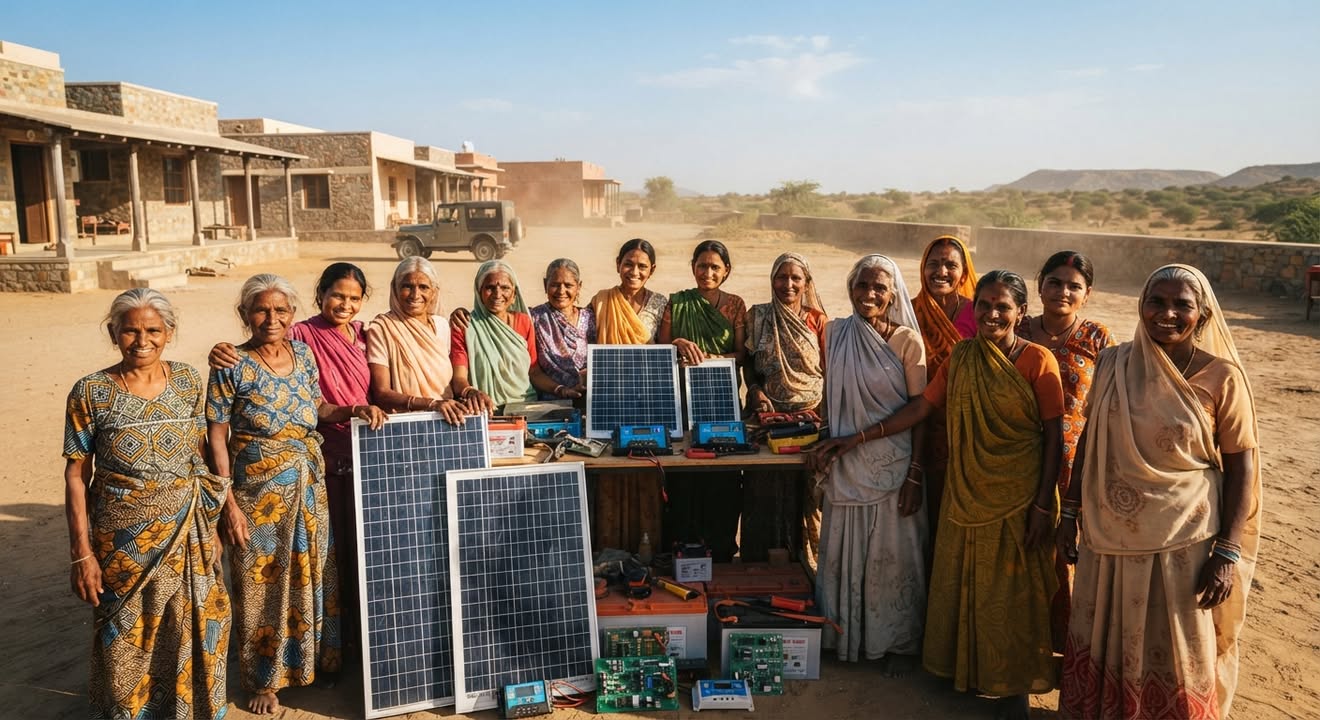
At a small college in India, women from some of the world’s most remote villages were learning how to build solar equipment. Many were grandmothers.
Some had little formal education, and others couldn’t even speak the same language as their classmates. Yet they were all there to learn something that would change life back home.
Over the next six months, they would learn how to assemble solar lanterns, connect electrical systems, work with batteries and fix equipment when something went wrong. Then they would return to their villages, where families had often spent their entire lives without dependable electricity.
A College That Did Things Differently
Barefoot College was founded in Tilonia, India, in 1972 by Sanjit “Bunker” Roy. His approach to education was different from what most people expected. He believed people living in poor rural communities already had valuable skills, and with the right training, they could solve many of their own problems.
Electricity was one of those problems. In remote villages, getting connected to a national power grid could be difficult or expensive.
Solar panels offered another way, but there was a catch. Someone had to know how to install them, maintain the batteries and make repairs when something stopped working.
Barefoot College decided to teach people who actually lived in those communities. That way, if a solar lantern stopped working or a battery needed replacing, families wouldn’t have to depend on a technician travelling from a distant city.
The lessons were designed for people who had never studied engineering. Instead of relying on textbooks and long technical lectures, instructors used photographs, colors, symbols and hands-on demonstrations. Students practiced the same jobs repeatedly until they could do them on their own.
Because women came from different countries and spoke different languages, much of the teaching happened through gestures and practical examples. A woman who couldn’t read an electrical manual could still learn which wire connected to which part, how to assemble a circuit and how to find a problem.
Why Grandmothers?
One of the most unusual parts of the program was its decision to recruit older rural women. Barefoot College became famous for training women who were often in their forties, fifties or sixties, many of whom had spent much of their lives raising families and working in their villages.
There was a practical reason for choosing them. Program organizers had found that younger people, especially men who learned valuable technical skills, were more likely to leave their villages in search of better-paying jobs. Older women generally had stronger ties to their families and communities and were more likely to remain there.
That made them ideal candidates for a job that needed someone available for years, not just a few months. When a family needed help with its solar equipment, the person who had been trained would already be nearby.
The villages helped choose the women who would receive training. Communities also agreed to contribute money toward maintaining the solar equipment, often using amounts similar to what families had previously spent on kerosene for lighting.
When the women returned, they had access to tools, spare parts and local workshops. They could install lighting systems, handle routine maintenance and repair equipment themselves. Some also earned income from providing those services.
The Program Reaches Ethiopia
In 2004, the approach received an important test outside India. With support from the United Nations Development Programme and Ethiopian authorities, 34 rural villagers travelled to Barefoot College to learn solar engineering.
After their training, they returned to Ethiopia and began bringing solar electricity to communities that had little or no access to conventional power. They installed systems, helped households use the equipment and took responsibility for keeping everything working.
Five years later, a UNDP report found that all 34 trained solar engineers were still serving their communities. More than 500 households across 16 villages had received solar electricity, and 170 portable solar lanterns had been put into use.
The project had also established 10 rural electronics workshops where equipment could be maintained and repaired. Families no longer needed to wait for outside help every time something broke. The trained villagers had the knowledge and equipment to handle many of those problems themselves.
From Afghanistan to Villages Around the World
The idea soon travelled farther. In 2005, Barefoot-trained engineers helped bring solar electricity to five villages in Afghanistan, reaching about 150 homes.
The same training approach continued spreading through communities in Africa, Asia and other parts of the world. Villages selected people they trusted, those people travelled to India for practical training, and they returned with skills they could use immediately.
In 2008, Barefoot College began working with an Indian government technical cooperation program to expand its international training. According to the college, that partnership eventually supported 24 training groups and helped 884 rural women become solar engineers.
Many of those women had never received the kind of education normally associated with technical work. Now they were assembling electrical equipment, installing lighting systems and teaching others how the technology worked.
For families who had depended on kerosene lamps, reliable solar lighting offered everyday benefits. Children could read and study after sunset. Parents could continue household work without burning as much fuel, and people could use community spaces after dark.
The Grandmothers of Ghana
The program was still producing results decades after those first international projects. In 2024, the United Nations Development Programme shared the story of five women from Ghana who had travelled to Barefoot College in India for training.
Three of the women were in their sixties. Together, they helped bring solar electricity to 150 households in communities that weren’t connected to the power grid.
They also took on the responsibility of maintaining those systems. Residents had people within their own communities who understood the equipment and could help when repairs were needed.
And something else was happening. Some of the women had begun passing along what they learned to younger members of their families, giving another generation the chance to understand and maintain the technology.
The grandmothers had travelled thousands of miles to learn how to bring electricity home.
Now they were teaching their children and grandchildren how to keep it there.