Remarkable Stories
Every Plane in America Was Grounded, but One Took Off With a Baby’s Liver
On September 10, 2001, doctors at Texas Children’s Hospital in Houston received some long-awaited news. A donor liver had become available in Nashville, Tennessee, and it appeared to be a match for a six-month-old girl named Kareena.
Kareena had been born with a condition called biliary atresia, which prevented bile from draining properly from her liver. She had spent most of her young life in the hospital, and by September, her liver was failing. Without a transplant, doctors feared she wouldn’t survive much longer.
Dr. John Goss, the surgeon overseeing her care, knew how rare the opportunity was. Finding a liver suitable for a baby that young was extremely difficult, especially one that matched both her size and blood type.
The plan was straightforward. A surgical team at Vanderbilt University Medical Center would recover the organ, a chartered aircraft would carry it to Houston, and Goss would perform the transplant.
Then came the morning of September 11. Following the terrorist attacks, the Federal Aviation Administration ordered civilian aircraft across the United States to land. Airports shut down, flights were canceled, and the charter plane that was supposed to carry Kareena’s liver was no longer an option.
One Phone Call Changed Everything
In Nashville, Jill Grandas, a coordinator with Tennessee Donor Services, received word that the normal transportation arrangements had fallen apart. The liver was still available, but there was no way to get it to Houston by air.
Driving wasn’t a practical solution either. The trip would take roughly 12 hours, far longer than the organ could safely remain outside the body using the preservation methods available at the time.
Grandas decided to try something unusual. She went to the mail room, found a telephone book, and looked up the number for the control tower at Nashville International Airport.
She called and explained the situation. A critically ill baby was waiting in Texas, and a donated liver was sitting in Nashville with no way to reach her.
Grandas expected an argument, or possibly an outright refusal. Instead, the woman who answered understood the urgency and began helping her find a solution.
Grandas later learned something unexpected about that conversation. The air traffic supervisor had a relative who was also waiting for an organ transplant.
The request moved through the appropriate aviation authorities, and permission was eventually granted for an emergency military flight. The Tennessee Air National Guard would provide the aircraft and crew.
A Giant Aircraft for a Tiny Passenger
The aircraft selected for the mission was a C-130 Hercules, a military transport plane designed to carry heavy equipment, vehicles, and large amounts of cargo. On September 11, its cargo weighed approximately 10 ounces.
Nine members of the Tennessee Air National Guard boarded the aircraft for the emergency flight. Their job was to carry the donated liver nearly 800 miles from Nashville to the Houston area, where another team would take over.
The C-130 received special permission to fly through airspace that had been cleared of ordinary commercial traffic. While thousands of passenger aircraft remained grounded, the military crew headed south with the small medical container.
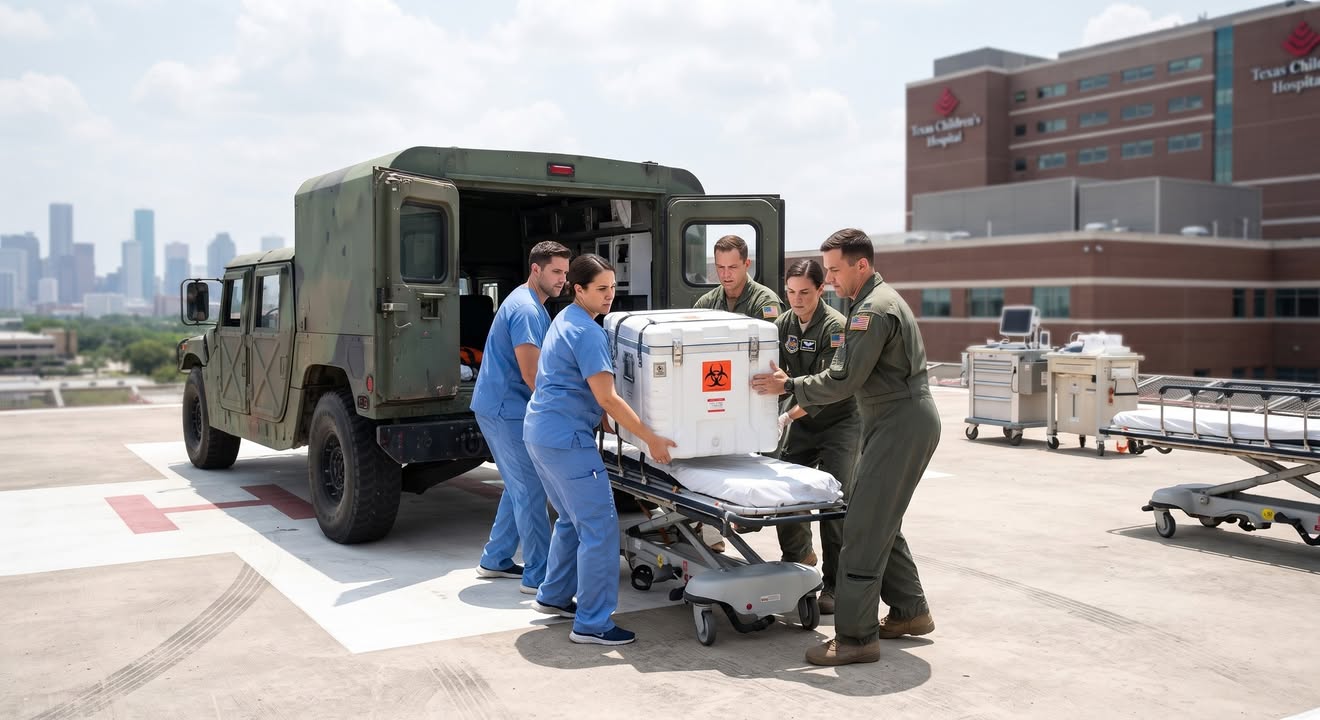
The plane landed at Ellington Field near Houston, where another group of Guardsmen was waiting. They transferred the liver into a military vehicle and drove it to Texas Children’s Hospital.
A Humvee eventually pulled into the hospital complex carrying the container. Inside, Goss and his surgical team were ready.
The liver reached the operating room, and the transplant went ahead that same day. By that evening, Kareena had survived an operation that had seemed almost impossible to arrange just hours earlier.
The Family Who Made It Possible
The extraordinary flight was only possible because of a decision another family had made the previous night. In Nashville, a family had lost their own infant. In the middle of their grief, they agreed to donate the baby’s organs, giving another child a chance to survive.
That donation eventually brought together surgeons, nurses, transplant coordinators, air traffic controllers, federal aviation officials, and military personnel. Most had never met, and they were working across two states during one of the most difficult days in American history.
Kareena survived the transplant and eventually left the hospital. She grew up in the Houston area, went to school, graduated from college, and began building a life that had once been far from certain.
Over time, she also learned more about the people who had helped her survive. One of them was Jill Grandas.
A Phone Call Every September 11
Years after the transplant, Kareena and Grandas began talking by telephone. The two developed a friendship despite never having met in person.
Their conversations eventually became an annual tradition. For roughly five or six years, Kareena called Grandas every September 11, remembering the day that had changed both their lives.
By 2026, Kareena was 25 years old and studying law, with an interest in health policy and improving access to medical care. Grandas, meanwhile, had become CEO of Tennessee Donor Services after nearly four decades working in organ donation.
As the 25th anniversary approached, they decided it was finally time to meet. On September 3, 2026, Grandas traveled to Texas. When she and Kareena spotted each other across a lawn, they walked toward each other and embraced.
There were tears, hugs, and plenty to talk about. Eventually, they found a picnic table in a nearby park and sat together, getting to know each other without a telephone between them.
Grandas later told Vanderbilt Health that their meeting felt surprisingly natural. Although they had only spoken by phone, their friendship had already lasted years.
Twenty-Five Years Later
On September 11, 2026, Kareena returned to Texas Children’s Hospital for another reunion. This time, she was meeting Dr. John Goss, the surgeon who had performed her transplant exactly 25 years earlier.
Goss was still working in transplant medicine, and Kareena was now an adult studying law. The last time he had seen her, she had been a critically ill baby whose future depended on a donated liver reaching Houston. They greeted each other with a hug and spent time talking about her life since the operation.
During an interview that day, Kareena also spoke about the donor family whose decision had made everything possible. She credited them, along with the many strangers who helped transport the organ, for giving her the chance to grow up.
And before she left the hospital, Kareena had one more request for the surgeon who had saved her life.
She wanted a selfie with Dr. Goss to show her mom.